

Part I opened with James I, and the same will be done here of his Stuart grandson. For it is James II’s removal in 1688 that marks the end of the traditional world and the beginning of the modern world. And it’s here that the products of the Reformation can again be found: James II, a Catholic and an absolute monarch, was defeated and subsequently replaced by the Protestant constitutional monarchy of William III.
Parliamentarism had won and Royalism had lost; Protestantism had won and England would never again have a Catholic monarch. The Crown would never again be sovereign vis-à-vis the Houses of Parliament. And though the terminology wouldn’t be invented for another century (then wouldn’t be popularized for several centuries thereafter) indeed this was a “left-vs-right” dispute, and one which had a clear winner.
Proportionate to Parliament’s relative share of power rising, England begins to become the first modern state, going on to check all of the boxes qualified by any standard definition of “modernized.” It’s a gradual process, of course, but one that finds a most recognizable point of origin. And to remind you, we are here to examine the origins of each component of modern life, and so a definition proves helpful in this respect. Two were provided in Part IV, but here’s something looser, and more targeted toward our end:
“Modernity,” “the modern world,” and “modernization,” are roughly interchangeable when used for the purposes of this series, and while it adequately represents our era, it is better understood as a system, rather than a period of time.
And embedded within the concept of “modernity” are a number of emblematic characteristics and pivotal events. Each of which has either determinately influenced the modern world’s trajectory or remains as a crucial structural element of modern life. Each characteristic is co-constitutive with modernization; and each can be thought of as a pillar upon which the modern world rests.
But what are those components? I will here provide a sample of five that hold particular significance:
Capitalism (market economies, more broadly)
Globalism (i.e., economic interdependence and international integration)
Industrialism (which is now in a post-Industrial, immaterial stage)
Liberalism (or representative forms of government)
The Modern Financial System (i.e., the accommodative central bank reserve system)
Preclude one of these components from development, and “modernity” becomes unrecognizable; it may retain the same label, but would be something else entirely. That’s because all features are more-or-less interdependent, all coevolved, all descend from a common ancestor, and all will be the subjects of the following post which indirectly targets each. In doing this, we’re gonna touch on like, a million “revolutions”... And I’m being dramatic, but we’re gonna arrive at the French and Industrial Revolution, and have already touched on the Glorious. Now onto it’s near-immediate aftermath—>
I. The Financial Revolution
Confusingly, there’s several different names for the 1688 revolution that was described at the outset. I tend to go with “the Glorious Revolution,” because that’s the one I’ve most frequently heard. But another name for it is “the Bloodless Revolution,” which I like because it’s a lie; it was quite bloody, making the name mildly humorous. Anyway, if that one was bloodless, the Financial Revolution is really bloody in contrast. Which is not obvious! But the Financial Revolution is the cause and consequence of many wars to be described, and I’ll begin bridging the Glorious-&-Financial Revolution by emphasizing that William III was a Dutch Prince. And to remind you, it is the Dutch Prince William III who Parliament invited to replace James on the Throne.
But the thing about Dutch Princes is that they tend to have particularly Dutch interests as any Dutchman would. And surrounding the Revolution in 1688, the Dutch had a continental dispute with the French. William’s promotion alongside England’s natural proclivity toward maritime hegemony, makes what followed from the Bloodless Revolution of little surprise:
“In May 1689, Parliament declared war on France, following the wishes of the new King, William III. For the next 25 years, with only one truce of five years, England was engaged in a long and expensive war with its neighbor across the Channel.”1
I’ll emphasize three things from UK Parliament’s quote here: (1) Parliament declared war on France, not the Crown, which now possessed a smaller share of power. (2) This war continued for roughly 25 years. And most importantly, (3) this war was expensive.
“At the end of this war it [England] emerged as the leading European power - and Parliament more powerful than before because of its increased control over the Crown’s finances.”2
This is where I’ll point out that the modernization of the financial system, as you’ll see, coevolves alongside sovereignty shifting from a monarchical center to institutional peripheries. And both factors, i.e., financial and political modernization correlate with a relative incrementation in frequency and intensity of warfare. Which is where I’m grounding our discussion of the Financial Revolution— in war.
But war alone does not explain what followed. Of concern is the ways in which the state was reorganized by war. The Financial Revolution was a structural transformation of power, and how power was financed, administered, and legitimized. The financial institutions built as a response to war would go on to contribute directly to the buildup of state capacity. Or as one scholar puts it, there was-
“positive joint causality between warfare and the expansion of both state capacity and financial intermediation.”3
The “financial intermediation” aspect marks a decisive break from the pre-modern world to be discussed throughout the remainder of this post. State-building depends fundamentally on the government’s ability to collect taxes, and it is considerably easier to collect them in money than in kind.4 We’ll observe a shift toward a monetized economy that becomes inseparable from the rise of the modern state. And crucially, this process was enabled by representative government itself.5 Once sovereignty was vested in Parliament, public debt could be reconceived not as a personal liability of a monarch, but as the collective obligation of citizens. In that sense, government borrowing became politically viable precisely because it was no longer royal, but national. But more on that later… For now:
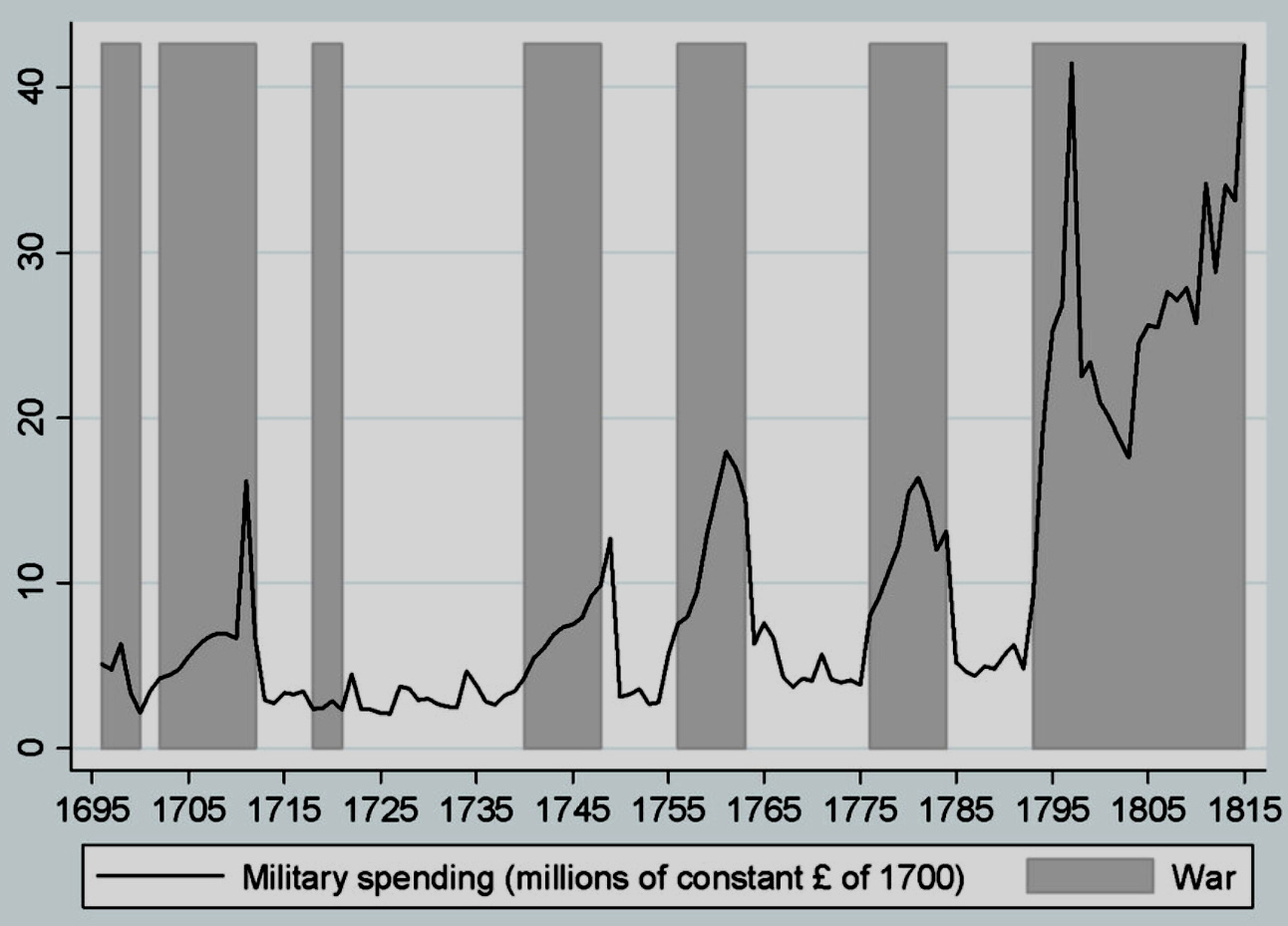
From 1689 to 1815 the English were in a declared state of war for over 50% of that time.6 As mentioned, war is expensive and something like, “Where did the Brits get the money for this?” might be a good question to ask. And the answer is, they didn’t have the money for it at all.
The modernization of war from 1688 onward became inseparable from the modernization of finance. War expenditures increased, but they also transformed in kind, demanding forms of capital that no longer existed as material coins or bullion. That is, modern wars could no longer be fought with the pre-modern, finite quantities of gold and silver, but with credit. And this all begins with “King William’s War,” the Nine Years' War described prior. We’ll see it ultimately gave rise to the bond and stock market as necessary financial instruments, but I’ll start that exploration by comparing the protype method of securing what has been called, the major sources of state revenue: 1. Taxes and 2. Loans (i.e., Debt).7
In the pre-modern age, a private subject of the king would travel on foot or by horse to a neighboring village. His intention being, to estimate what commodities its residents might have, levy an indirect tax on a select few goods, and take the loot back to… wherever it was that accorded with the Crown’s demands. This form of fiscal revenue acquisition was called tax farming. It was an arduous and imprecise process, often entailing embezzlement and scarcely yielding consistent results. I’ve simplified things, it can be read about more here, but roughly speaking, this was the way in which England levied taxes for most of the 17th century.8
As you might imagine, this was not very lucrative for the state… As it turns out, it was not very lucrative for the tax-farmer either… O—don’t feel bad about him though. Being a tax-farmer was actually an entirely voluntary position. And to make this odd vocation even more foreign; it was the tax-farmer who paid the king to secure his position. And yes, yes, there’s actually a very good reason for him doing this, but the key thing to know for now is that tax farming served two familiar roles to the state: (1) tax revenue and (2) debt.
So the tax-farmer collected taxes—duh. But what about the debt part? And why did he pay to be employed as a tax farmer? The answer to both questions are the same: He paid for this role because he got to keep whatever money was collected in excess of the King’s imposed levy (which the tax farmer presumed to be more than the down-payment given to the king at the outset). Did the tax farmer know this would be lucrative? He didn’t! But it worked out frequently-enough, I guess. He was a speculator, and a prototype lender who is doing the pre-modern equivalent of a citizen paying for a bond. And the King was okay with him taking excess payments—why? For the same reason the U.S. is okay with paying interest on bonds; to receive more cash now, at the expense of interest on debt to be paid later. King’s would recruit tax farmers when they needed liquid “cash” which was provided by the tax farmer’s down-payment.9 The excess to be lost could be worried about later. As for now, the king needed to pay for jewels and harlots, or whatever it was that kings liked to buy.
“That’s all well and good, but what does this have to do with the transformation into modernity?”—would be a fair response. But worthy of emphasis, is that the tax farming system was not very lucrative, and the king knew this. Simply, taxes were not expected to be a decisively generative source of state revenue for pre-modern states. But all states need revenue, and in noting that there was no income tax at this time, I’ll also emphasize that monarchical revenue most often came from external sources. Internal sources like taxes were inconstant, only imposed based on temporary necessity, and only ever limited to things like customs (i.e., duties on international, not domestic trade), excises (i.e., domestic taxes on particular goods such as alcohol and tobacco), and the occasional land-tax, for those fortunate enough to own any.10
Why did they need to super-charge their fiscal capacity? Because of the substantive debt incurred during the Nine Years War and subsequent War of Spanish Succession; the same wars that I mentioned earlier, having been declared by Parliament and brought about under the new (and notably Dutch) King William III.
How did they raise their fiscal capacity? England gradually dismantled the private and inadequate tax-farming system, then replaced it with a centralized, state-regulated apparatus of tax collection. This new fiscal institution employed far more tax collectors, improved the flow of receipts, and introduced increasingly sophisticated methods of record-keeping and calculation. These administrative advances allowed taxation to expand incrementally over the war-ridden eighteenth century without collapsing under political or logistical strain. Although indirect taxes remained the primary source of state revenue, the decisive change after 1688 was the dramatic increase in fiscal capacity —and it only accelerated in the decades that followed.11
Furthermore, the Bill of Rights created in 1689 precluded the King’s power of levying taxes, codifying Parliamentary control thereof. And the tax revenue would no longer be directed by tax farmers toward the King’s purse. Rather, the Exchequer would be the final destination of all receipts, and it was to be collected by state employed bureaucracy—the aforementioned apparatus. From there, the Treasury would oversee taxes, public funds, and the creation of annual budgets, not the King.
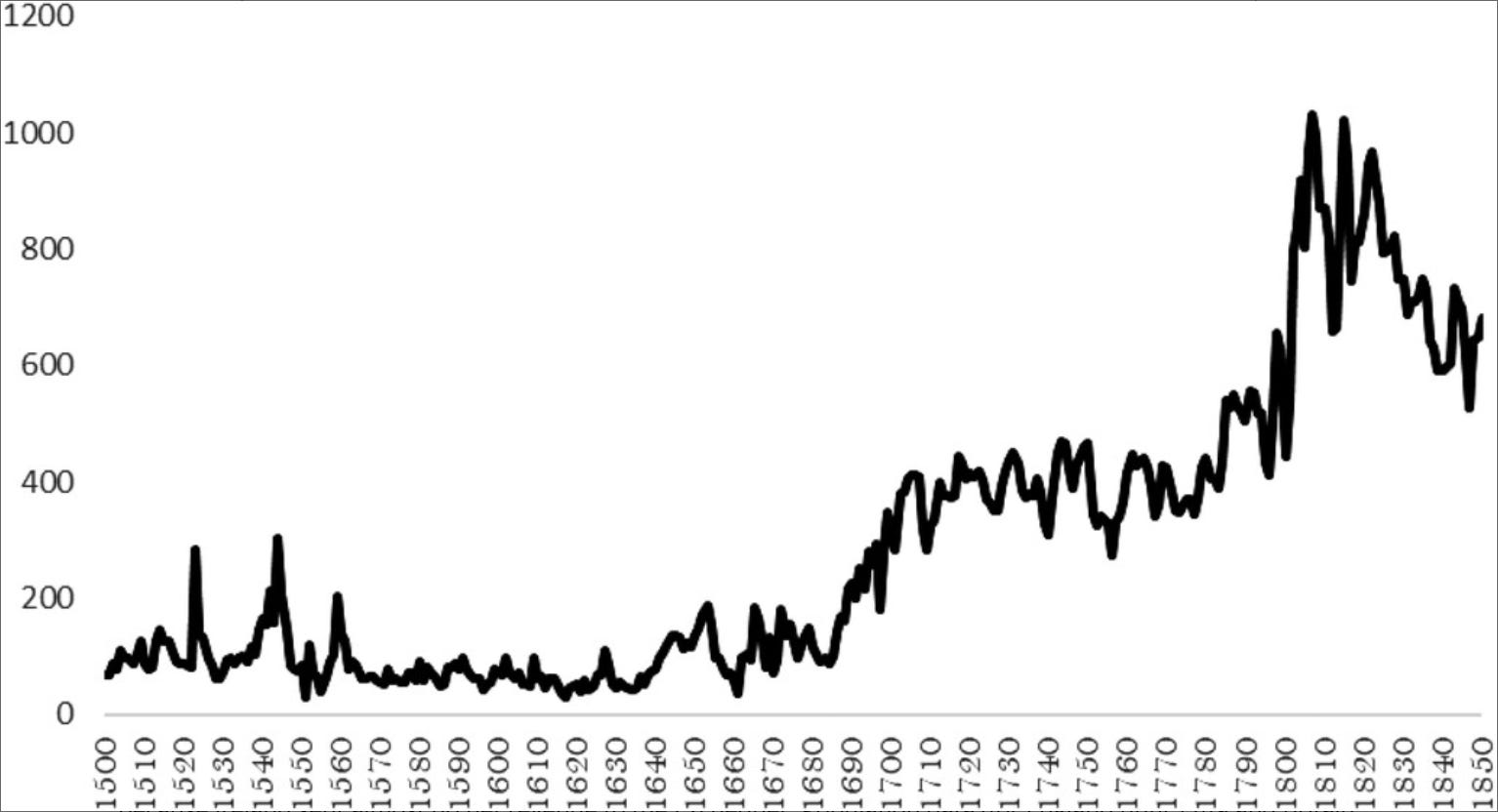
As to “why” this had to happen is the increase in interstate conflict. As to “how,” well we’ve touched on the expansion of the tax apparatus already, but there is another reason …But before we get to it, take a gander at this graph representing the ascent of England’s fiscal capacity from 1500-1850 in real terms. Note that it’s essentially stagnant throughout the “tax-farm era,” and remains so until about 1688.
Now, onto the other thing. This one is more interesting and of far greater significance than the taxation component of revenue. Remember 1. and 2.? Taxes and Debt.
Loans are an interchangeable word for debt, and Deficit financing is the more accurate term I’m getting at here: Debt can be remembered by three C’s, as it can be defensibly argued that it’s the primary cause, consequence, and constant of the British empire built from the period 1688-1815. So too does debt remain represented by those same “three C’s” in all modern hegemons, as my fellow American readers might attest. But for now we are only concerned with it’s origin in early-modern England. And here I wish to draw your attention toward debt’s propensity to act as a source of power, not simply as a cost of power.
Theoretically, monarchs could levy taxes, and in addition they could take more money from their subjects whenever they really really needed to. But representative democracies (or proto-representative democracies, in this case) have to do something way more subtle when they need more money, lest they face electoral consequences or loss of legitimacy. Parliamentary England needed their wealthier citizens to give up loot voluntarily- how? They sell government-backed securities (i.e., bonds, bills, etc.) to speculators who pay [X price], and speculators want to do this because they’re promised to be paid back [X price]+[interest]. But citizens will only be creditors if they believe that the state is both capable and willing to consistently pay off the debt. This requires trust.
How does a government acquire that trust? Well, there’s a few ways. For one; remember how the Brits rose their fiscal capacity? Remember the second graph? Smarty pants, I knew you would (: …Anyway, the consistent incrementation of taxes signaled to lenders that the state would be able to pay back the debt, lending to enhanced confidence of creditors.
BUT—! There’s actually another way that offers itself up for display quite nicely, and it relates to a profoundly important component of this narrative that has hitherto gone unmentioned. I’ll introduce it by quoting, that “no other institution contributed more to the stability of the [Glorious] revolution settlement.”12 I’ve delayed this long enough: The institution referred to is the Bank of England, which was chartered by Parliament in 1694, and it would become the prototype of most modern central banks today.13
Though, it wouldn’t officially be nationalized as a central bank until 1946.14 Instead, the Bank was chartered under the Tonnage Act as a private joint-stock company, only implicitly tied to the state rather than formally incorporated into it. That it was private and not technically public, is an answer to the question that opened the last paragraph: this “private” status helps explain the trust it quickly commanded among creditors. The Bank operated as a legally distinct intermediary between Parliament and investors, so public borrowing was no longer seen as a direct extension of state discretion. Instead, it was mediated through a corporate body with what was perceived to be enforceable contracts, predictable interest payments, and dedicated tax revenues. So paradoxically, it was precisely the Bank’s private character that enhanced the credibility of public finance15. But this notably private institution was chartered with the stated intent as follows:
for secureing certaine Recompenses and Advantages in the said Act mentioned to such Persons as shall voluntarily advance the summe of [£1,500,000] towards the carrying on the Warr against France.16
So it was chartered to continue the war with France, and it would be used for this purpose for the following century until 1815. In this case, the Nine Years’ War was the precipitating cause. I should further emphasize that before 1688, England was not a world power. In 1788, however, Britain was the world power, and it was one built on debt. Debt = Good?? You tell me. Read this passage by historian John Brewer on the state’s ascent from 1688-1783:
“From its modest beginnings as a peripheral power—a minor, infrequent almost inconsequential participant in the great wars that ravaged sixteenth and seventeenth-century Europe—Britain emerged in the late seventeenth and early eighteenth centuries as the military Wunderkind of the age. Dutch admirals learnt to fear and then admire its navies, French generals reluctantly conferred respect on its officers and men, and Spanish governors trembled for the safety of their colonies and the sanctity of their trade. European armies, most notably those of Austria, Prussia and the minor German states, marched if not to the beat of British drums then to the colour of English money. Under the early Stuarts England had cut a puny military figure; by the reign of George III Britain had become one of the heaviest weights in the balance of power in Europe. She had also acquired an empire of ample proportions and prodigious wealth. New England merchants, Southern planters, Caribbean slaves and Indian sepoys were subject to her authority. No sea was safe from British traders; even the Pacific and the Orient were beginning to feel the British presence. Thornhill’s Painted Hall at the Naval Hospital at Greenwich (1717–25), with its extravagant depiction of Britain’s military power, contained its share of wish fulfilment, but the allegorical presence of the four continents was not misleading: Britain was on the threshold of becoming a transcontinental power.”17
Yes, yes, the glaze is unreal… But it’s not inaccurate. Now compare the British ascent to a graph representing the incrementation of their public debt during the long 18th century:
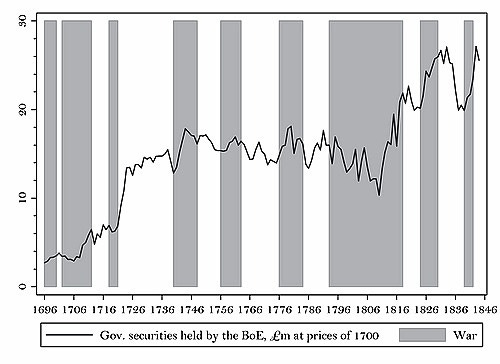
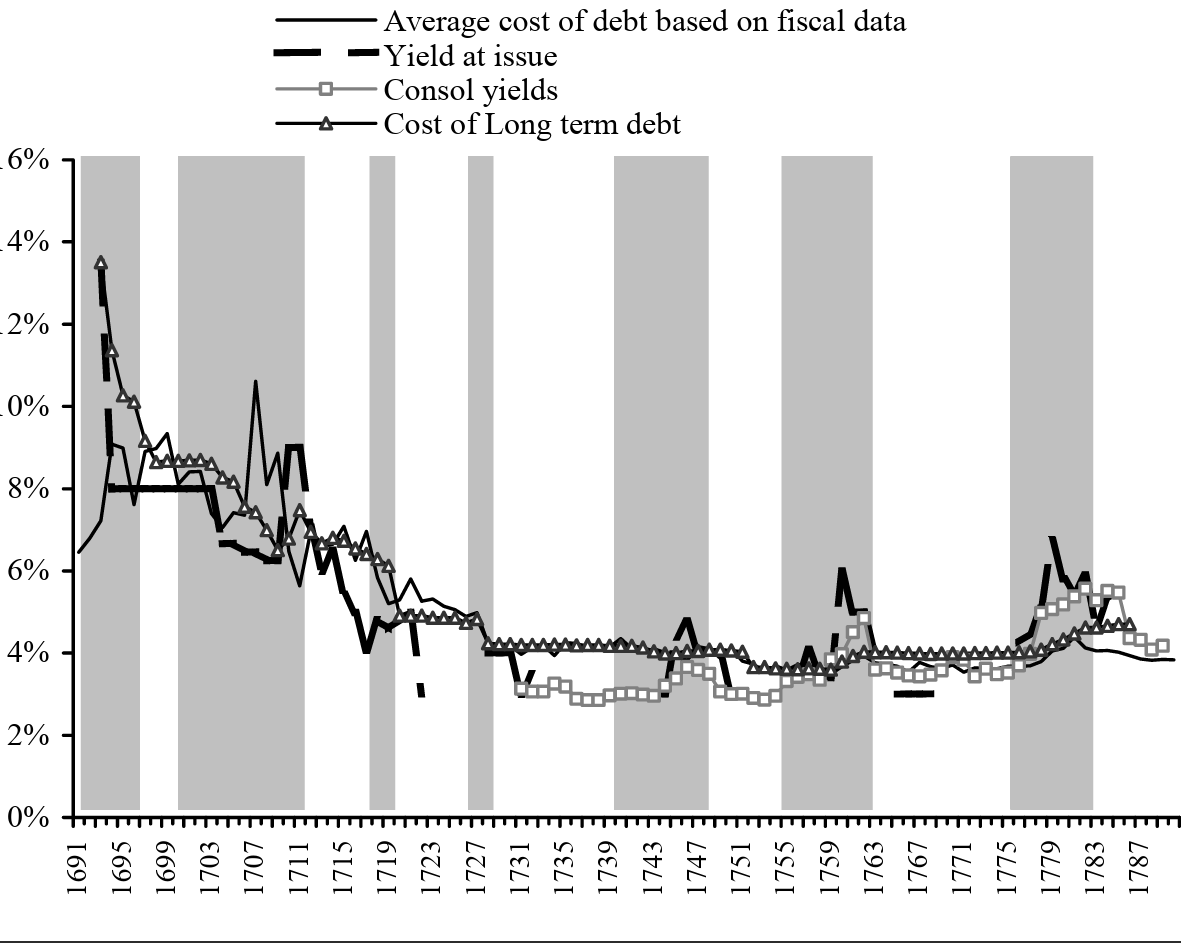
But more debt is bad right? Apparently not, because receiving voluntary loans from wealthy citizens and private speculators would enable the modern state to spend beyond its own means, and more crucially, to spend what their pre-modern enemies could yet afford. Now let’s compare the state’s debt to the relative cost of debt once inflation could be used as a tool to lower the real price that was owed:
In the coming post I intend to show that the Bank of England would go on to play a causal role not only in Britain’s industrial development, but also in the geopolitical struggles that culminated in the French Revolutionary and Napoleonic Wars. The Industrial Revolution and the French Revolution are often treated as the origins of the modern state. Without diminishing their significance, I argue that both were downstream consequences of a path already set in motion by the Glorious Revolution and its financial aftermath.
And finally, the modern nation-state was not necessarily developed due to representative government, nor was it necessarily made by the transmutation of subjects into citizens, nor the contrived fantasy of “rights” bestowed, nor industrialization, nor was it any such consequence of the real cause: The monetary economy became a financial economy- from which everyone was more easily taxed. Yes! That is speculative provocation this post will close on; it seems to be taxation, i.e., the ability for the state to reliably generate revenue that led to the modern nation-state. Each factor that tends to follow from this, private property, bureaucracy, citizenship, all of it is functionally equivalent to easing the ability of the state to collect taxes.
UK Parliament. “The Financial Revolution.” Living Heritage: Evolution of Parliament – Parliamentary Authority. UK Parliament, n.d.
https://www.parliament.uk/about/living-heritage/evolutionofparliament/parliamentaryauthority/revolution/overview/financialrevolution/
UK Parliament, “Financial Revolution.”
Patrick K. O’Brien and Nuno Palma, “Not an Ordinary Bank but a Great Engine of the State: The Bank of England and the British Economy, 1694–1844,” European Review of Economic History 24, no. 2 (2020): 322.
Patrick K. O’Brien and Nuno Palma, “The Engine of the State: The Bank of England and the British Economy, 1694–1844,” European Review of Economic History 24, no. 2 (2020): 312.
L. Randall Wray, The Origins of Money and the Development of the Modern Financial System, Working Paper No. 86 (Annandale-on-Hudson, NY: The Jerome Levy Economics Institute of Bard College, March 1993), 29.
Rahman, S. Ahmed Explorations in Economic History Fighting the Forces of Gravity - Seapower and maritime trade between the 18th and 20th centuries, 34
John Brewer, The Sinews of Power: War, Money and the English State, 1688–1783 (London: Unwin Hyman, 1989), 76-77.
John Brewer, Sinews of Power, 75-80.
John Brewer, Sinews of Power, 75-80.
John Brewer, The Sinews of Power, 80.
John Brewer, Sinews of Power, 81.
Henry Roseveare, The Financial Revolution, 1660–1760 (London: Longman, 1991), 40.
George A. Selgin, “Central Banks as Sources of Financial Instability,” The Independent Review 14, no. 4 (Spring 2010): 486.
John Brewer, The Sinews of Power, 74.
Patrick K. O’Brien and Nuno Palma, “The Engine of the State: The Bank of England and the British Economy, 1694–1844,” European Review of Economic History 24, no. 2 (2020): 317.
Bank of England Act 1694, 5 & 6 Will. & Mar. c. 20 (Eng).
John Brewer, Sinews of Power, introduction, x.
Great read!