

In Part II, I related the emergence of capitalist market economies to the Reformation. I did so by reiterating Max Weber’s tying of the “Protestant ethic” to the “spirit of capitalism.” In the next few posts I wish to address the same relationship, but with added depth and more specificity.
The intention behind my exploratory analyses is to observe the origins of modernity through the lens of a theoretical model that positions the Reformation as the root source. That is only one framework (of many) that can provide a narrative schema to help integrate one’s understanding. Modernity is something worthy of comprehensive study, because it comes with many great and terrible things that we do not know how to handle. Such things can be better managed when they are first identified.
With that, I will restate that modern market economies are individualized economies. To be clear:
A market economy is an economic system in which individuals and firms exchange goods and services in a largely unfettered manner. To most people, this seems like a natural state of affairs, but until fairly recently, it was the exception, not the norm. In many preindustrial societies, people subsisted on the fruits of their own labor and engaged in very limited trade. In feudal Europe, most people were legally bound to a particular lord and manor and could not exchange their labor for a wage anywhere they pleased. The creation of the modern market economy required that feudal bonds restricting labor be broken so that most people would become dependent on market exchanges. In modern industrial and postindustrial societies, virtually the entire population depends on earning a wage or receiving a share of profit via the market.1
With the demise of the mercantilist era and emergence of market economies, we again locate a modernized social structure that was transformed through decentralization.
Reframing the orientation of cultural systems from collectivistic to individualistic is the key characteristic to note when relating modernized social structures to their Reformed root. The Reformation is to be treated as an era that influenced this transformational cascade which follows a characteristic pattern: It expresses itself through supplanting a stabilizing center, removing representatives of collective interest, then relegating that interest to the self.
Part I mentions the Reformed motivation to develop a “personal relationship with God,” obviating the Church as an intermediary. Symmetrically, market economies take the shape of a personal relationship with economic consumption, in the place of state-oriented mercantilism. I will emphasize that this economic transformation is a decidedly crucial one in relation to our end-point of modernization.
Once authority is decentralized in the religious sphere, it becomes increasingly difficult to maintain centralized coordination in the economic sphere. The mercantilist state, whose coherence depended on an undivided sovereign directing national wealth toward national strength, was incompatible with a culture that had already been taught to think and act through the individual.
The observance of that change will first demand attention be directed toward the great power conflict it was subsumed in, which ultimately lead to globalization.
III. The First Global Empire
In 1990 following the then inevitable fall of the Soviet Union, Charles Krauthammer published an infamous paper entitled The Unipolar Moment.
The collapse of America’s one and only peer-competitor came with many faulty assumptions rooted in optimism (see Fukuyama 1992), But Krauthammer's wasn't one of them. Indeed, it was a unipolar moment yielding uncontested U.S. hegemony for (at least) the following 35 years. The Americans had won The Long American Century—the name of which, really should have given it away.
And I’ll conclude that decoy by pointing out that the fall of the Soviet Union was not the first unipolar moment. In 1815 following their victory against Napoleon, the British Empire was left with no serious rival. And not only was this true on the European stage, but no nation on earth could provide adequate challenge vis-à-vis the English.
Preceding their American offspring by almost two centuries, the British had removed their most significant rival, and their sea-power was left uncontested to birth the Pax Britannica. This God-like power disparity afforded ample opportunity to restructure the world in their own image, which is precisely what they did. But how did they do it?
For the two previous centuries Great Britain and France had been in a declared state of war for over 50% of that time,2 and it was the conflictual dialectic between them that induced the Britts to build up a soon-to-be hegemonic navy.
The first thing to understand about the British Empire is that it was a maritime superpower, much like the United States is today; dominance was maintained through regulation of trade and finance more so than direct means of power projection.
When considering the U.S. and Great Britain, note that a body of water surrounds each (separating them from the conflictual European continent), and that one descends from the other, and that one ends up inheriting its fathers global empire. We have lived in a globalized maritime world order ever since 1815.
And I know I’m hitting you with geopolitics 101 here, a subject many of you already know, but it must be emphasized; being surrounded by water makes your civilization a naval one. You build boats gosh darn it. But here’s the thing, you don’t just build a navy—no. The navy follows from something more integral: Trade. If you’re Brittain, it is commodities that you want to send to France, to Germany, and so on. Theoretically, you give, say, France you largest pre-industrial export—wool—and they give you gold or something like that in return.
But, then what happens? Well, the French don’t want to pay for your wool, and why woold they? They can simply take it from you and sink your ship. So what do the French do? They build a fleet to go take your Anglo-ass-wool, and send you to Davey Jones’ locker in the process.
The King gets word of this, and he’s pissed! So, what does he do? He says fuck you France; I’ll just surround my merchant ship with a flotilla and hella canons. This is how an arms race begins. This is how a navy becomes a navy– but remember, it started from trade.
Here’s “the most important American strategist of the nineteenth century”3 recognizing the same thing, writing just prior to the United States becoming its own maritime superpower:4
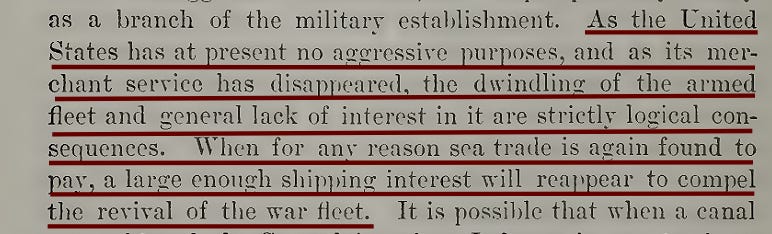
Sea power was not the only source of British hegemony, there was a related, but separate component of crucial interest to the topic of modernity: The British established the first modern financial system and central bank, which I intend to discuss in the next post of this series. But I’ll conclude here by discussing the nature of maritime powers in relation to their chief antagonists, the continental powers. Conveniently enough, S.C.M. Paine (Emerita from the U.S. Naval War College) published an article in Foreign Affairs quite recently covering that very subject:
She opens by explaining the distinction. Continental states treat power as measured in land. Most states inherit this reality by virtue of geography; they are hemmed in by neighbors who have, across centuries, been sources of danger.
The great continental hegemons (e.g., Germany, Russia, China, etc.) do not arrive at their worldview arbitrarily. Given their contiguity with other states, they tend to recognize that proximity has always meant vulnerability. It is entirely understandable that they imagine the international order as something to be divided into broad spheres of stability and control. They direct immense resources toward borders, militaries, and they often preempt threats. They have a survival-oriented logic, that is in a sense, more “based.”
By contrast states with an oceanic moat have relative security from invasion. They can thus focus on compounding wealth rather than on fighting neighbors. These maritime states see money, not territory, as the source of power. They advance domestic prosperity through international commerce and through industry, minimizing the tradeoff between military and civilian needs. While continental hegemons gravitate toward finite-game, winner-take-all strategies that are ruinous to the defeated, those vested in the maritime order prefer the infinite game of wealth-compounding, mutually beneficial transactions. They view neighbors as trade partners, not enemies.5
Maritime imperialism is quite different than continental imperialism. Maritime imperialists, with their primary intent of profit, tend to only want subsumption of the world into itself, i.e., into the market. This is a more peaceful alternative. Soft power becomes more relevant than hard power, and you often attract alliances by means of trading partners. The cost of this strategy, on a long enough time-scale seems to be a globalized monoculture. All of which is premised on trade, which for better or worse, seems to work really really well.
But monocultures present a problem: they are not cultures in any meaningful sense. As Hegel understood, identity arises only through determinateness, i.e., being that is what it is, by being distinct from what it is not. Identity is a product of contrast, something that the maritime world order has been fighting against since 1815.
Orvis, Stephen Walter, & Carol Ann Drogus. Introducing Comparative Politics. 6th ed. Thousand Oaks, CA: Sage Publications, Inc., 2025. Retrieved from https://vantage.sagepub.com/student/KIMJIN-1464/ch-10-political-economy-of-wealth-the-market-capitalism-and-the-state.
Rahman, S. Ahmed Explorations in Economic History Fighting the Forces of Gravity - Seapower and maritime trade between the 18th and 20th centuries, 34
The American Civil War Knopf, 2009, 272.
A. T. Mahan, The Influence of Sea Power upon History, 1660–1783 (Boston: Little, Brown, 1890), 26
S. C. M. Paine, “By Land or by Sea.” Foreign Affairs, August 19, 2025. https://www.foreignaffairs.com/united-states/land-or-sea-paine.