

One helpful way to think about religious denominations is to understand them as firms. Each firm is competing for a higher number of adherents in a market of religious consumers, and each firm advertises to be the one true religion.
Prior to the Reformation, the Catholic Church had a monopoly; they retained all shares in terms of potential believers in Western Europe. There was no free and open competition in this religious market, which means that it wasn’t a market at all. The Catholic monopoly bound the Holy Roman Empire, and following the Reformation, market competition ensued as it decayed the unifying belief that underpinned the European stage. The Empire lost its primary source of legitimacy as religious upstarts began their attempt at becoming the most appealing or the most rewarding in terms of ‘spiritual goods’ to incentivize growth.1
Of course, it’s an exaggeration to describe the Holy Roman Empire as a unified whole. The confederation was not utopic nor was it peacefully conjoined in Christendom. It may accurately be described as decentralized, but there was something resembling a stabilizing core to this fragmented imperial state, and it was represented by its political and spiritual leaders: The Empire and the Roman Catholic Church. Reciprocally, the faith provided legitimacy to the imperial state’s operating system, and the state ensured monopolistic privileges to the faith.2 Often this was done by force, the system was far from harmonic, but to varying degrees, it kept a large portion of Europe on the same page.
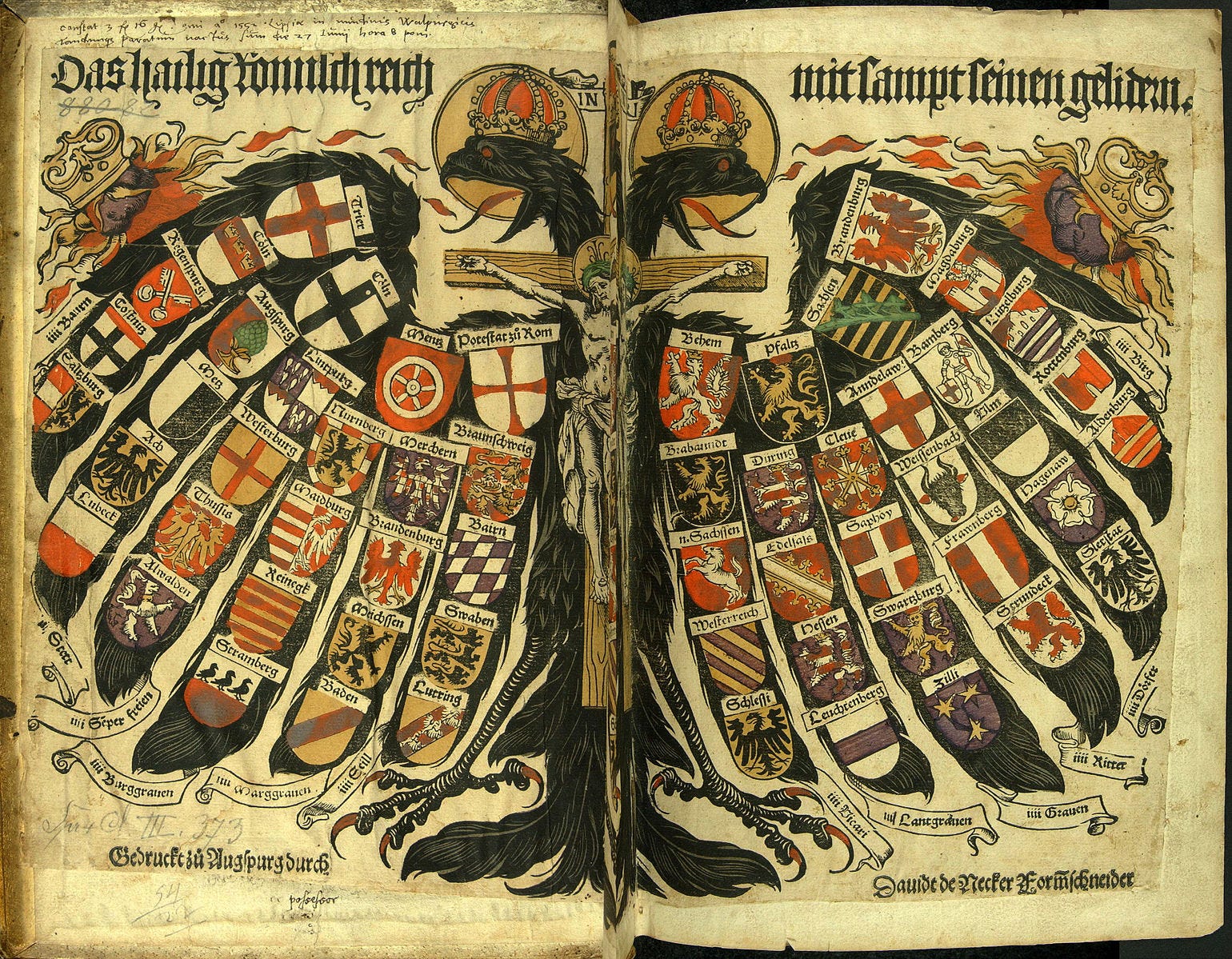
More importantly toward our end, is that the monopoly managed to keep the nearby maritime power on a distinctly continental leash. Note: the relatively secure, geographically separate English remained Catholic at the time of Martin Luther’s birth in 1483.
Now - we’re not concerning ourselves with English religious preferences, instead, I’ll translate what their Catholicism signifies for our purposes: England still sat inside the jurisdictional orbit of Rome, i.e., the latent maritime power conceded to a higher court across the English Channel, and were thus influenced by the continental power of the age. This would all begin to change within the lifespan of Luther, and the Brits would not become politically autonomous until they removed their Roman collar.
When they finally did, successive maritime powers would retain global influence and dominate their continental counterparts, as they’ve continued to do so ever since.
Crucially, maritime domination looks very different than it does in continental form. And this discussion lends to a broader thesis that is either directly or indirectly underwritten in everything in the text that follows. It will most certainly present as underwhelming unless you are an unusually excitable reader, but I submit it here only in its most digestible form for the time being: Maritime powers and continental powers have different strategic imperatives that, over time, select for different cultures, and institutions.
A more ambitious hypothesis, that frankly, should excite you (to the point of standing up, yelling at your screen and so on), is shorter in length, barely altered, but less likely to be widely accepted: Populations evolving from disparate environments have differing values.
In any case, all that is worthy of reflection (for now) is the rather basic and hardly original maritime-continental dichotomy. It was prefigured in Part III of the series, and it will be emphasized here, but due to my aversion to repetition, I’ve stolen a treatment from West Point’s Modern War Institute. How lazy!— I concede. But my thievery was also done, in part, to display the currency that this geographically inclined perspective holds among top American strategists and security elites.
“Continental powers emphasize territorial control, overland trade routes, and maintaining security through land-based military capabilities. They prefer to focus on immediate border threats and influencing the affairs of neighboring states to maintain border or territorial security. Continental powers traditionally utilize territorial conquest or overland trade to address national resource constraints. [. . .]
Although these states would acquire and often utilize naval forces, their primary imperative was territorial expansion for state security, creating a centralized economy, and a unified national culture. These priorities would often lead continental powers to govern through centralized governance to maintain territorial security and political rule. [. . .]
Maritime powers have unique strategic attributes making them distinctive from their continental counterparts. Where continental powers see territory to be taken, maritime powers see markets to facilitate cumulative economic growth. [. . .]
[M]aritime power identity, which is characterized by control of trade and trade routes, an emphasis on commerce, and more inclusive forms of government such as republics or constitutional monarchies. [. . .] Maritime power states evolved out of the periphery of early civilization, not at the center as great continental powers did, and thus had to rely on more open societies to enable trade and commerce to meet their resource needs.”3
Good. It now feels necessary to clarify two things before continuance: Firstly, the Roman Catholic Church, the Holy Roman Empire, Charles V, the Pope, or any other symbol that represents a node of the continental Empire’s overlapping power structure, will be amalgamated into a single concept; the variate terms will then be used interchangeably for the remainder of this piece.
And again, Catholic authority provided a relatively centralized source of legitimacy for a fragmented imperial order. That legitimacy was continental in location and largely derived from theological sources. Because England still recognized that source of legitimacy, the continent retained leverage across the Channel. That is, until there was a transformation of power that occurred in proportion to the Reformation, which was most hastily adopted by the maritime powers.
Now—! We’re going to observe that 'transformation of power' in a unique way: We’re going to refer to the prior described concept represented by the Holy Roman Empire and Catholicism as “Hitler I.”—Why? Well don’t take this too seriously, but I am loosely recognizing the fact that Adolf Hitler served a similar role in terms of intent, as a continentalist. That intent being; a drive toward an expansive, continental, and European land mass that was knit together through conquest and some form of unified belief.
That too, I mean in a very specific way. There’s much more to this notion, and it will be explored at length in this post and others. But what I’ll preemptively dissuade my lovely reader from (hi), is a misleading proclivity to examine world historic phenomena through a left-vs-right lens. Almost in contradiction, that’s actually a lens I encourage you to use! Just not while ignoring the underlying dichotomies that make it “left” or “right” to begin with.
Among other things, the Reformation and Modernization series has largely been about intersections of interwoven contrast. To name a handful; Protestant vs Catholic, liberal vs conservative, free trade vs mercantilism, industrial vs agrarian, the nation state vs the imperial state, representative governments vs feudal-monarchies, and maritime vs continental orders. Such distinctions are what underpin the concept of modern vs pre-modern, and yes, to a large degree, left vs right as well.
Of course, it isn’t as “black and white” as that mere summary above describes, but for now we’re still only concerned with the internal components of modernity at their root. And to continue with that exploration.—
Whether or not “Hitler I” recognized the latent imperial potential inherent to the British Isles, Hitler II and III certainly did, as both Napoleon and Adolf respectively faced it in its actualized form. It’s worth noting that all Hitlers in this mildly-humorous schema failed to unite the continent (or large swaths of its territory) for any lasting period of time. Furthermore, the maritime powers with their Reformed undercurrents were able to subdue the continental forces with a progressive degree of ease relative to the advancement of time. This topic is expansive, and I begin with the latter, the most recent, and the most 'Hitler' of the three—we’ll reverse-engineer things from there.
R&M. Part VI, Section I: Hitler III.
“Since 1945, scholars have debated how much continuity links the Nazis and their predecessors. In the foreign policy realm, however, there is widespread agreement that Hitler did not represent a sharp break with the past but instead thought and behaved like German leaders before him.”4
“Ecology: a branch of science concerned with the interrelationship of organisms and their environments.”5
It is, of course, very silly to consider Charles V as Hitler I, Napoleon as Hitler II, and Hitler as Hitler III. And it’s extra-silly, (if not just egregiously 'clickbait-y') to enumerate them and place Adolf himself as the third edition… Yes, yes, I know. But silliness aside, there is reality to this simplification that I intend to illustrate in the text and editions that follow.
If you recall, various components of the Holy Roman Empire were aggregated a bit earlier, and we transformed the notion into a simplifying representation of the whole. We’re now going to invert that process with Hitler III— we’ll disaggregate it, find out what it truly represents using one core component, then work backward until the shared motivations held by Hitler II (i.e., Napoleonic France) are ready to be adequately demonstrated. We’ll continue that process until arriving back where we started: the Reformation.
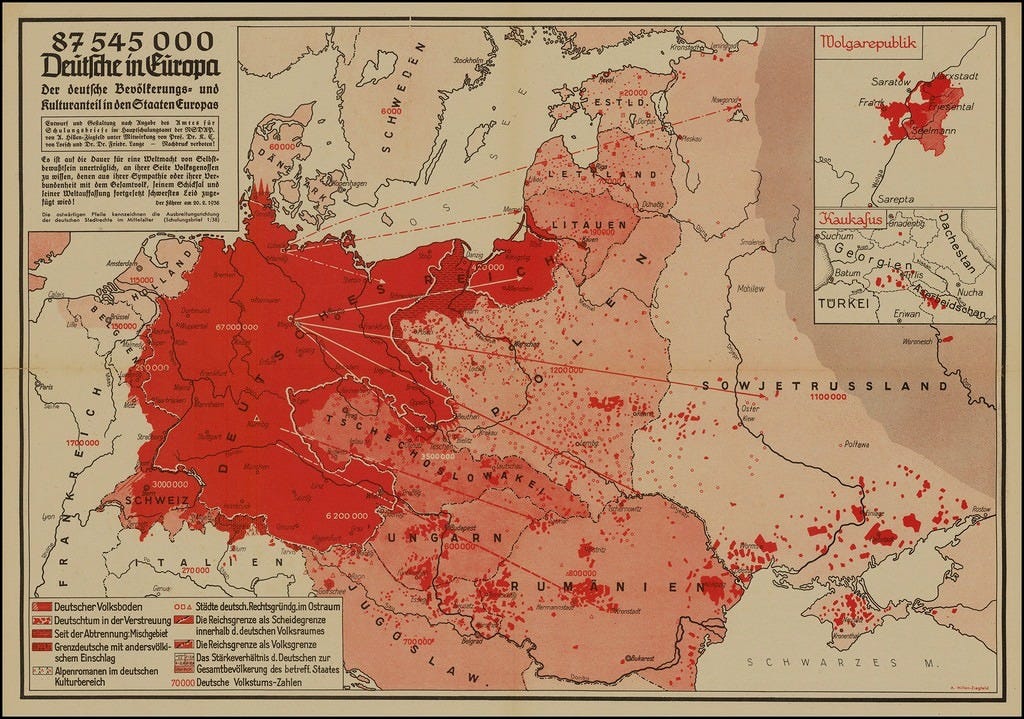
Lebensraum is the component I’ve chosen to extract from Hitler III, and it’s arguably causal in relation to the Second World War.6 The exploration of this component will not (and should not) be separated from an exploration of the causes of the First World War; the First cannot be separated from the Second. The best way to understand a war is often to understand the one that came prior, and symmetrically, the 20th century cannot be understood without the context of the 19th; the century will take almost the entirety of our attention in regard to Hitler III—who is, “himself,” first explored here through the vehicle of Lebensraum.
But there are two ways of thinking about Lebensraum: one from connotation and another from denotation. The former implies the policy-oriented, expansionistic aspirations of Germany during the World Wars—and this would be, an entirely accurate, but superficial implication that the word tends to relay. The lesser-known definition of Lebensraum leads us to an intriguing theory of biogeography and anthropogeographic development. This definition precedes National Socialism by several decades, and the context of its derivation finds roots nearer to the 1840s than the 1940s.
Somewhere between those dates is 1897-1901, when Friedrich Ratzel applied Darwin to civilizations, cultures, and the populations therein; he related them to their environment, and turned Darwin’s “the struggle for life” into “the struggle for space.” Darwin was translated, then introduced to Germany in the 1860s only a few months after his publication of The Origin of Species.7 As Darwin did, Ratzel recognized the environment as playing a decisive role in relation to the evolution of organic life, and it was from Darwinian principles he would develop Lebensraum to mean “the geographical surface area required to support a living species at its current population size and mode of existence. The exact boundaries of a species' Lebensraum were relative to its members' metabolic requirements and environment, and [their Lebensraum] expanded as population grew.”8
Regarding the quote above, the first half is clear-enough, but the latter demands emphasis: Ratzel describes the “metabolic requirements” of a group as rising in proportion to population growth, i.e., as there is an increase of the population, (and particularly, if a population increases while that population seeks to maintain an agrarian social-economic environment—which demands vast territory for sufficient farmland), so too will the need for more “living space” grow.
Ratzel was a scientist more so than an ideologue, his theories remain compelling in so far they rely on Darwinian architecture, and there’s even some scholarly Post-War debate on how much of the concept should be revived.9 Certainly, there are a few problems with Ratzelian Lebensraum that one may identify—and yeah, one of them is “-the War!” Yes grandpa, but what I’m getting at, is that emigrationist colonial ideology underpinned Ratzel’s science.10 Any conflation of any ideology and science tends to be sufficient cause to discredit even valid theories (supposedly), and I presume that this led to unfortunate foreign policy decision-making displayed in the Second World War.
More on that later, but what is emigrationist colonial ideology? Its adherents treated overseas settlement as a means to reduce domestic pressure; exporting surplus population while trying to preserve an agrarian national core abroad.11 In answering the question further, I’ll remind you that the late-19th/early-20th century was the high colonial era in which the maritime British Empire led as the dominant colonial power, and the British were followed by the French. Germany was behind in third, and were the last of the three to industrialize and to form a colonial empire. Germany’s actions from the 1840’s to the buildup of the First World War must be understood in the context of the desperate need to modernize. Within that dynamic, Germany had a population problem as well as many interrelated social problems. The latter of which expressed itself in Germany’s 1848 Revolution, but all concerns were descent from growth —an enormous component of the broader modernization study this series aims to provide.


Growth will be meant in three ways, but first only two: population growth and economic growth. Like many dyadic pairs reviewed in this series, they are a cause and consequence of each other. 'More people' are causal in relation to more labor and more demand; more output means more mouths can be fed and more children can survive to then go on and reproduce further. Within this chain of causality is another familiar piece of the 'modernity puzzle,' and it serves as a history-dividing catalyst: the Industrial Revolution that took place from roughly 1760 to 1840 accelerated the process by inducing more production while markedly lowering the costs of survival.
Among the political consequences downstream of the Industrial Revolution, few are more identifiable than those seen in the second half of the 19th century. German territories were reorganized by the accelerating process: rural life was displaced, urbanization became a means of containing the abundant new population, regional-class conflict intensified as owners of industrial capital economically outcompeted their agrarian counterparts, and legitimacy became fragile because the old agrarian order no longer held significant power in the new demographic and economic reality. This is the period in which Germany consolidated itself into a nation-state in 1871, and it is also the ecological context in which thinkers like Ratzel applied “growth” to a third variable: space. If a society seeks to remain substantially agrarian while its population rises, then land is seen as a metabolic requirement, and territorial expansion is then perceived as necessity.
Indeed, colonialist Germans like Ratzel saw land as a life-or-death necessity, and it was cohabited by a broad variety of other fears stemming from shifting market conditions and technological innovation.12 In regard to colonialism itself, it’s easy to moralize about it post hoc; to see it as pure greed or malicious conquest, but in the nineteenth century German environment it served as a management strategy: a strategy for externalizing domestic pressure, whether by securing raw materials and markets or by exporting surplus people (who were feared to be dispossessed revolutionaries, in many cases) into settlement frontiers13. Emigrationist colonialism is the conservative-agrarian version of the management strategy: it aimed at conservation of the threatened peasant class (who were often believed to be the basis of national identity14) by moving them somewhere else, rather than allowing for their dissolution by industrialization at home. Colonialism in the German case was not a cause of growth, but a management strategy thereof.
“Emigrationist colonialism and conservative agrarianism shared the same basic assumption: that excessive industrialization was socially and economically bad, that the proper basis of a stable and powerful German society was a traditional agricultural economy, and that correct foreign policy centered around opposition to, rather than cooperation with, the leading industrial power-Britain.”15 […]
The emigrationist theory prescribed overseas settlement colonies as the solution to a number of social problems, of which the most important was the Auswanderung, the massive nineteenth century emigration from Germany. Large numbers of Germans, displaced by economic and social changes in Germany, could settle as farmers in these colonies as an alternative to emigration to America or elsewhere. The settlement colonies would “protect” the emigrants’ culture, retain their contributions to the German economy, and recreate overseas the type of traditional peasant society which many regarded as the basis of national power and which was threatened by the process of industrialization.16
So Friedrich Ratzel was a member of this Emigrationist movement, promoted their strategies, and the post-1840s environment he lived in (having been born in 1844) influenced his theory of environments in relation to culture arising therefrom. Later, his work would be used as a motivating justification for Hitler III’s expanse, but for the early German state, emigrationist colonialism retained two utilities. The first was domestic as it gave Otto von Bismarck and conservative parties (of whom Ratzel was a member17) a vehicle for coalition building and for advancing non-liberal economic policies under a popular wing whenever it was necessary to gain broad middle-class support:
The appeal of emigrationist colonialism was recognized by Bismarck, the conservative parties, and the right-wing National Liberals, who sought a vehicle to forward non-liberal economic policies with popular support. Bismarck’s colonial policy, therefore, despite its substantive basis in the economic colonial theory, was partly occasioned by his desire to harness pro-colonial (emigrationist) middle-class opinion in order to push his general economic policy past left-liberal opposition and to achieve a consensus of the conservative and right-liberal parties with wide popular support. Such a consensus was possible on colonial issues primarily because of the prior existence of the emigrationist colonial ideology.18
The second utility relates to what is meant by “non-liberal” above: for reasons to be described, it will mean non-British for our purposes (anti-maritime works here too). But in addition to emigrationist colonial ideology was economic colonial ideology. This variety of colonialism was often, but not always at odds with the emigrationists. Generally, to an economic colonialist (a) industrialization was seen as inevitable, and (b) they were more willing to subordinate agricultural priorities to industrialize further, and increase export capacity.
So far I have only treated the social pressure behind emigrationist colonialism, but I should mention that economic colonialists were mostly disciples of the German economist Friedrich List, who recognized that the concept of free trade was ''coincidentally'' most advantageous to the very nation who invented and promoted it—i.e., Great Britain. Liberal trade is functionally equivalent to free trade, and free traders argue on behalf of lowering trade barriers like tariffs, which is an entirely unsurprising ideology to support for those with their interests tied to a maritime, inherently-trading Empire. Especially unsurprising and convenient if that Empire relied on protectionism until their own Industrial Revolution, and only then discouraged protectionist trade barriers for everyone else thereafter.
List, in fact, agreed that liberal/free trade may well be mutually beneficial to trading states, as the British economists prescribed, but only if the trade is between two industrialized, developed nations. Otherwise, a developing nation ''freely'' trades with a developed nation at the cost of leverage, i.e., the former becomes locked into a state of economic dependence with the industrial power, who will inevitably provide more substantive goods and have little to no reliance on the wellbeing of the non-industrial power. Promotional of the idea that states should use protectionism until national industrialization makes free trade viable, List developed what became known as the Infant Industry Argument in 1841, which was a response to disproportionate levels of industrialization, and the disproportionate trade advantaged to Great Britain relative to the rest of the world as a consequence.19 This disparity followed from the British-derived Industrial Revolution, the British-derived Adam Smith, and Smith’s British-derived theory of international trade; all of which were promoted as universal moral goods; all of which lent to economic leverage granted to Great Brit— you get the idea..
There’s much more to be said on Listian thought, but it’s beyond the scope of this article. I would highly recommend this for those interested, but for now: economic colonialists were German nationalists favoring industrialization; the national economy was valued over international free trade—which they saw as dependence on British imports; they were comfortable with the cost of tariffs, saw it as a future investment in an industrialized Germany, and they were willing to forego the cheap British goods on offer to support their own nation’s economy in its stead.
German colonial projects in either their emigrationist or economic form, can be viewed as a way to reduce dependence on a maritime world economy that was disproportionately shaped by Britain. Britain, along with France were Germany’s primary rivals from 1871-1945; from Germany’s consolidation until the Second World War, the British possessed the maritime environment that Germany’s modernization processes and outcomes had to survive within. As German leaders understood from Bismarck onward, continental industrial power can grow to hegemonic status, but they must do so through (a) the build-up of enough naval-power to control inputs and trade routes, or, (b) secure enough territory (in terms of land-mass) to the extent that it no longer remains reliant on external goods or the maritime-controlled trade thereof.
But the latter option would have entailed an expansion into other great-powers; there were few powers to invade that wouldn’t incite a great-power war as Germany bordered the French at one end and Russia at the other from 1870-1914; meanwhile France and Russia were (rightfully) assumed to ally in such a war, making German defeat all but certain at any time from the consolidation of Germany to at least 1903—when Germany became the dominant industrial power of Europe, and even then, such a war’s victory would be enormously questionable, British involvement notwithstanding.20 Nevertheless, as they felt it was a necessity, Germany opted to challenge the great powers, but only from afar by establishing overseas colonies, furthering industrial might, and slowly building up maritime means to eventually get to their security-induced ends by challenging the British position as a regional hegemon. As described, the state harnessed domestic support from urban economic, and rural emigrationist blocs to its convenience; code-switching between pro-industrialist and pro-agriculturalist arguments alike, they were all to unite under the common aim of territorial expanse as a means of preserving national autonomy. Ratzel served a role in this wider project as his science could be latched onto by colonialists of any variety needing of a legitimizing theory to back territorial growth.
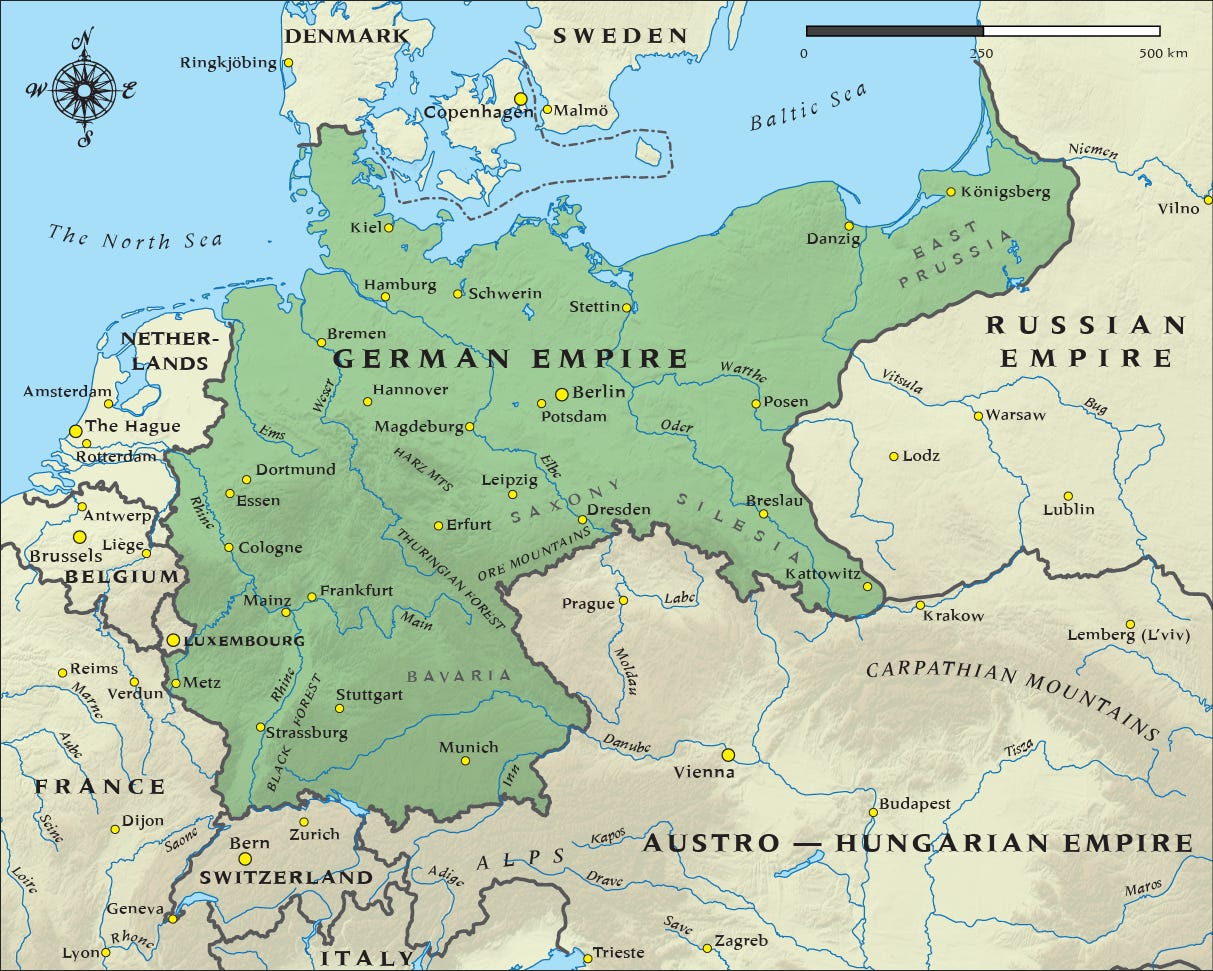
With this context the German strategy of Weltpolitik is intelligible. In essence, it was a bid to make Germany’s position abroad “commensurate with her new industrial might;” a deliberate shift away from Bismarckian caution and toward a more flamboyant global posture.21 As you can imagine, the thalassocracy of Great Britain didn’t make Germany very confident in the long-term prospects of their overseas colonial holdings acquired in the 1880s. And absent reliable overseas space, German leaders increasingly looked to a continental solution- which would later arrive in the form of Ober Ost and the Generalplan Ost in WWI and II respectively. But industrial dominance wasn’t going to be enough to get them there; continental nations cannot become a global power in a world connected by sea lanes without either joining the sea lane system on terms acceptable to its custodian, or building the coercive tools to renegotiate those terms.
That renegotiation attempt is why the naval program began. Germany’s battleship building “opened the door to the Anglo German naval race,” with the Navy Bills of 1898 and 1900 laying out “a massive naval expansion under anti British auspices,” aiming at a 2:3 capital ship ratio so the German fleet would have a credible chance in a defensive war in the North Sea.22 Short of hegemonic naval capacity, a fleet that could inflict unacceptable damage could still coerce Britain into accepting German equality as a global empire.
Britain’s response, which was entirely predictable, was to not accept the continental rival threatening their position. A maritime hegemon cannot afford a peer competitor in the one domain that gives it power vis-à-vis the continent. Naturally it will do anything it can to defend its status on the world stage, which is why In 1905 the British intelligence department began planning for a naval blockade of the continent, as economic warfare had always their staple; from the blockade, “between 478,500 and 800,000 civilians died from diseases related to hunger and malnutrition.”23 But not before 1908, when the British construction and war planning increasingly shifted its attention toward the battleships rising across the North Sea.24
And with the naval buildup mentioned between the British and German rivals… I trust you know where the story goes, but I will be happy to return to the subjects of the First and Second World War before long. For now, I’ve gone on quite long about only a small component of the more ambitious project I intend to display. This piece has mainly gotten at three concentric circles of an interconnected idea: the outermost shell is the broader, series-defining exploration of modernity at its roots. The next, more specific subject was the establishment of “three Hitlers” representative of continental powers that are characterologically expansionistic, centralized, and they seek to restrain or to oppose Maritime hegemony—and this was done to emphasize the point that geographic environments predispose nations to adopt characteristic values based on a common set of survival strategies. Relatedly, finally, and most specifically, this piece has told the story of Lebensraum’s invention by Friedrich Ratzel, who I will now conclude with.
Like everyone else, Ratzel developed his views as a product of things that came before him. For Ratzel, like most in the 19th century, what structured his worldview was the division of history; the undoing of the social-political order that evolved as a consequence of the Agricultural Revolution, then being undone by the Industrial Revolution, as it introduced a new social-political order in it’s post-1840 aftermath. Ratzel was born in 1844, and it was within this ecological environment that Lebensraum would be developed, and from where it would be mimetically selected for by Hitler III, just prior its transmission being largely punished by extinction.
And with the imperative of expanding agricultural space, Hitler III would go on to treat the description offered by Ratzel as a prescription to invade the agrarian “breadbasket” of Europe, and this happened to be in the possession of the USSR in 1941. The incitement of a two-front war would be the beginning of the end for both the connotation, and the denotation of Lebensraum. With British possession of the seas, then wedged between two continental great powers, the German environment has never been generous... As John Mearsheimer describes, “Security was always a burning issue for Germany because of geography: it is located in the center of Europe with few natural defensive barriers on either its eastern or western flank, which makes it vulnerable to invasion. Consequently, German leaders were always on the lookout for opportunities to gain power and enhance the prospects for their country’s survival.”25 But, on some level, would that geographic reality in relation to the World Wars’ conclusion not support the very ideas behind Lebensraum to begin with? In observance of human affairs through an ecological and evolutionary lens, it’s as though the failure of Lebensraum as a political project, itself confirms validity of the theory in it’s originary, geographically inclined form: the environment matters.
Ironically, I couldn’t help but notice while researching Friedrich Ratzel the frequency with which authors would at once reject Ratzelian Lebensraum due to it’s reputation, and would then go on to explain precisely how it was shaped and transmitted through the.. historical-social-cultural-political-geographic-technological-genetic-etc. environment (and this was always mentioned, if not directly, then by default). Lebensraum, as a theory or otherwise, was shaped by its own founding principles, or at least addressed the geographic composite of the broader umbrella implied by the word “environment.” So perhaps, to a degree, the denotation of Lebensraum had to destroy its own connotation to confirm itself.
But I wont get too carried away: Ratzel has been described as a “spatial determinist,” and my broader, evolutionary-ecological approach to human affairs considers more factors than merely location. As a final note; if Friedrich Ratzel could have seen what his theory of Lebensraum ended up doing to his own living space at the end of the War, I doubt he would have published any work on the subject, and perhaps no work at all. Who knows. To the extent that its own undoing implies a form of confirmation, and perhaps led to some improved-upon modification, it would be an almost Greek tragedy-esque Aufheben of a story. And its telling can’t be done without the context of the Industrial Revolution of 1760-1840.., but subsumed within that period, there is another Revolution to be addressed; it began in 1789 and it culminated in 1815 following the defeat of Hitler II at Waterloo. Until next time… Ciao.
Sascha O. Becker, Steven Pfaff, and Jared Rubin, “Causes and Consequences of the Protestant Reformation,” Explorations in Economic History 62 (2016): 5.
Henry Kissinger, World Order (New York: Penguin Press, 2014), 12-14.
Matthew Sansone, “When Maritime and Continental Powers Collide: A Historical Framework for US Asymmetric Competition with China,” Modern War Institute, November 26, 2024, https://mwi.westpoint.edu/when-maritime-and-continental-powers-collide-a-historical-framework-for-us-asymmetric-competition-with-china/
John J. Mearsheimer, The Tragedy of Great Power Politics, updated ed. (New York: W. W. Norton & Company, 2014), 182.
Merriam-Webster, s.v. “ecology,” accessed February 23, 2026, https://www.merriam-webster.com/dictionary/ecology.
Murtoff, Jennifer. “Lebensraum”. Encyclopedia Britannica, 13 Mar. 2025, https://www.britannica.com/topic/Lebensraum.
Cecilie Abrahamsson, “On the Genealogy of Lebensraum,” Geographica Helvetica 68 (2013): 38, citing Oskar Peschel (1860).
Cecilie Abrahamsson, “On the Genealogy of Lebensraum,” Geographica Helvetica 68 (2013): 37-44, https://doi.org/10.5194/gh-68-37-2013.
Woodruff D. Smith, “Friedrich Ratzel and the Origins of Lebensraum,” German Studies Review 3, no. 1 (February 1980): 52.
Woodruff D. Smith, “Friedrich Ratzel and the Origins of Lebensraum,” German Studies Review 3, no. 1 (February 1980): 57.
Woodruff D. Smith, “The Ideology of German Colonialism, 1840–1906,” The Journal of Modern History 46, no. 4 (December 1974): 641.
Woodruff D. Smith, “The Ideology of German Colonialism, 1840–1906,” The Journal of Modern History 46, no. 4 (December 1974): 655-656.
Friedrich Fabri, Does Germany Need Colonies? (1879), published in: German History in Documents and Images, https://germanhistorydocs.org/en/forging-an-empire-bismarckian-germany-1866-1890/ghdi:document-1867.
Woodruff D. Smith, “The Ideology of German Colonialism, 1840–1906,” The Journal of Modern History 46, no. 4 (December 1974): 662.
Woodruff D. Smith, “The Ideology of German Colonialism, 1840–1906,” The Journal of Modern History 46, no. 4 (December 1974): 641.
W. R. Lee, “Economic Development and the State in Nineteenth-Century Germany,” The Economic History Review 41, no. 3 (August 1988): 357.
Woodruff D. Smith, “Friedrich Ratzel and the Origins of Lebensraum,” German Studies Review 3, no. 1 (February 1980): 59.
Woodruff D. Smith, “The Ideology of German Colonialism, 1840–1906,” Journal of Modern History 46, no. 4 (December 1974): 641–662, doi:10.1086/241266.
Mehdi Shafaeddin, “What Did Frederick List Actually Say? Some Clarifications on the Infant Industry Argument,” UNCTAD Discussion Paper no. 149 (Geneva: United Nations Conference on Trade and Development, July 2000), 4, https://unctad.org/system/files/official-document/dp_149.en.pdf.
John J. Mearsheimer, The Tragedy of Great Power Politics, updated ed. (New York: W. W. Norton and Company, 2014), 184.
William A. McDougall, “20th-century international relations,” Encyclopaedia Britannica, June 3, 2025, https://www.britannica.com/topic/20th-century-international-relations-2085155.
Dirk Bönker, “Naval Race between Germany and Great Britain, 1898-1912,” in 1914-1918-online. International Encyclopedia of the First World War, ed. Ute Daniel, Peter Gatrell, Oliver Janz, Heather Jones, Jennifer D. Keene, Alan Kramer, and Bill Nasson (Berlin: Freie Universität Berlin, January 11, 2015), https://doi.org/10.15463/ie1418.10536.
Dirk Bönker, “Naval Race between Germany and Great Britain, 1898-1912,” in 1914-1918-online. International Encyclopedia of the First World War, ed. Ute Daniel, Peter Gatrell, Oliver Janz, Heather Jones, Jennifer D. Keene, Alan Kramer, and Bill Nasson (Berlin: Freie Universität Berlin, January 11, 2015), https://doi.org/10.15463/ie1418.10536.
Alan Kramer, “Naval Blockade (of Germany),” in 1914-1918-online. International Encyclopedia of the First World War, ed. Ute Daniel, Peter Gatrell, Oliver Janz, Heather Jones, Jennifer D. Keene, Alan Kramer, and Bill Nasson (Berlin: Freie Universität Berlin, January 22, 2020), https://doi.org/10.15463/ie1418.11451.
John J. Mearsheimer, The Tragedy of Great Power Politics, updated ed. (New York: W. W. Norton & Company, 2014), 181.
Another great read! This was very well thought out.