

Prior to the French Revolution, European armies were relatively small and they mostly consisted of foreign mercenaries.1 The National Assembly changed this pre-modern norm with the levée en masse; the conscription of “all able-bodied unmarried men between the ages of 18 and 25.”2 The political technology, transforming subjects into "citizens" expanded the French army from having numbered ~150,000 men in 1792, to ~700,000 in 1793; France had become the largest army in Europe within a year, and this made it a potential Continental hegemon.3
Along with the quantitative advantage, the modernized army would gain a qualitative advantage after a coup led to new, self-coronated leadership. The Emperor would go on to manhandle his pre-modern Continental neighbors: Napoleon took on Prussia, Austria, Belgium, the Dutch Republic, Bavaria, Hanover, Saxony, Switzerland, the Italian Peninsula, Portugal, Spain, Russia, and the British Empire; each of the Continental states were occupied at some point during the war, leaving only the Maritime exception.4
But the exception proved to be more interesting than the rule. Britain was France’s chief antagonist throughout the Napoleonic Wars, and more broadly, since 1689 at the dawn of the Second Hundred's Years War; an eight-part conflict that began with England’s Glorious Revolutionary settlement. The new Dutch King of England, William III, and his sovereign, the newly empowered Parliament, would proceed to form a balancing coalition against the Sun King, Louis XIV of France—who, at the time, retained both naval supremacy and near-hegemonic power over the Continent. Only through the combined efforts of the Grand Alliance; the English, the Dutch, and the Habsburg monarchy, could France be balanced against.5 The Sun King would be defeated in this war, and over the course of the following century, Britain and France would be in a declared state of war for over 50% of that time.6 All the while, British incrementation in naval power rose in proportion to the French declension thereof.
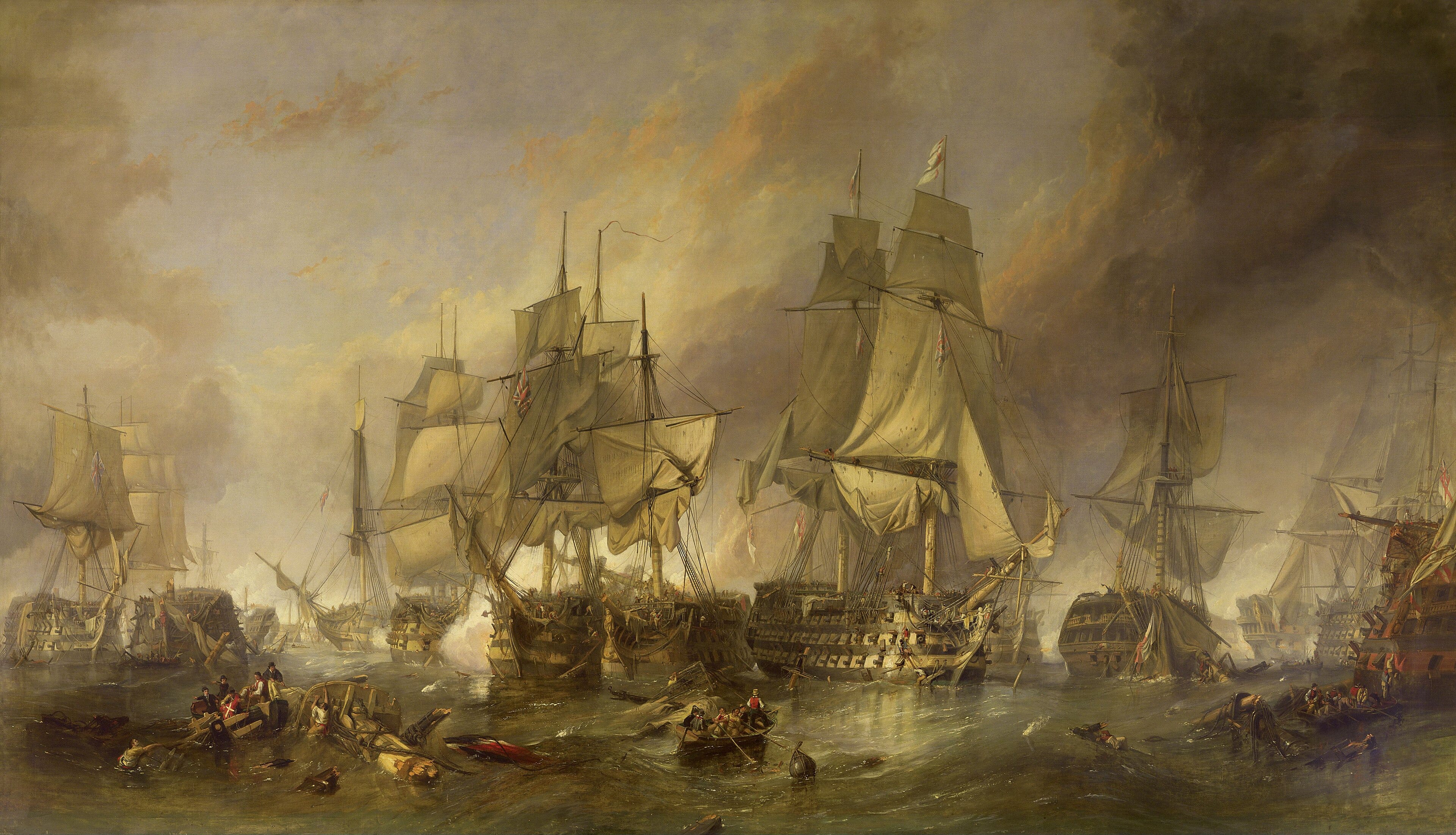
It’s often recognized that the 1805 battle at Trafalgar solidified the British Empire’s famed naval supremacy held throughout the long nineteenth century.7 But this littoral struggle is rarely considered in its wider context: the bout began in the late seventeenth century, with the English entry into the War of the Grand Alliance in 1689, and Napoleon did not enter the ring until the eighth and final round.
Thucydides would have appreciated the long arc of this conflict as a declining power carried through three Louis and one Napoleon, each one facing off with a rising power across the Channel. The age of the Sun King’s amphibious rule had decisively passed upon the sea duel of 1805; decimating the French fleet, the British “triumph essentially concluded the naval struggle between Britain and France and ended Napoleon’s hopes of either invading Britain or restoring a French overseas empire.”8
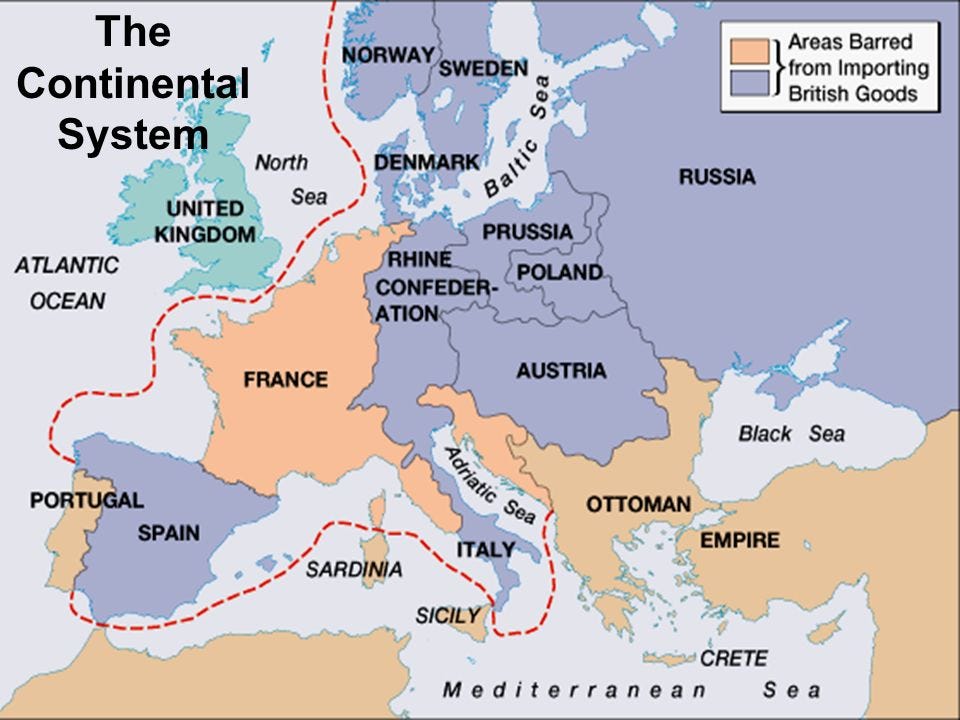
Now left with few options, Napoleon thought better than to re-fight a shark in the water, and instead aimed to hit the commerce oriented power where it hurt most. Aptly named: the Continental System would be “the most important policy after 1806;” the year marked the Berlin Decree which “prohibited all trade between Britain and Europe;” with this decree, Napoleon had “ordered the seizure of goods originating from Britain and its colonies and the incarceration of all English subjects on the Continent.”9
Napoleon was thinking not dissimilarly to a German mentioned in my last post. Friedrich List, born in 1789, the same year as the Storming of the Bastille, would hold a Napoleonic, Continentally protective view articulated in his National System of Political Economy. Both Bonaparte and List alike recognized the Continent would develop reliance on British trade while Britain was in its burgeoning Industrial Revolution. Each observed the power this provided to the maritime hegemon and arrived at similar conclusions, the actualization of which would make for similar consequences as faced by France after 1806 as well as Germany in the First and Second World Wars.
For reasons to be described, autarky is enemy No. #1 for any maritime hegemon, and it’s of the few state behaviors they will traverse their own protective moat and enter into a costly war to prevent. More on this relationship to come, but put briefly, maritime powers rely on Continental reliance.
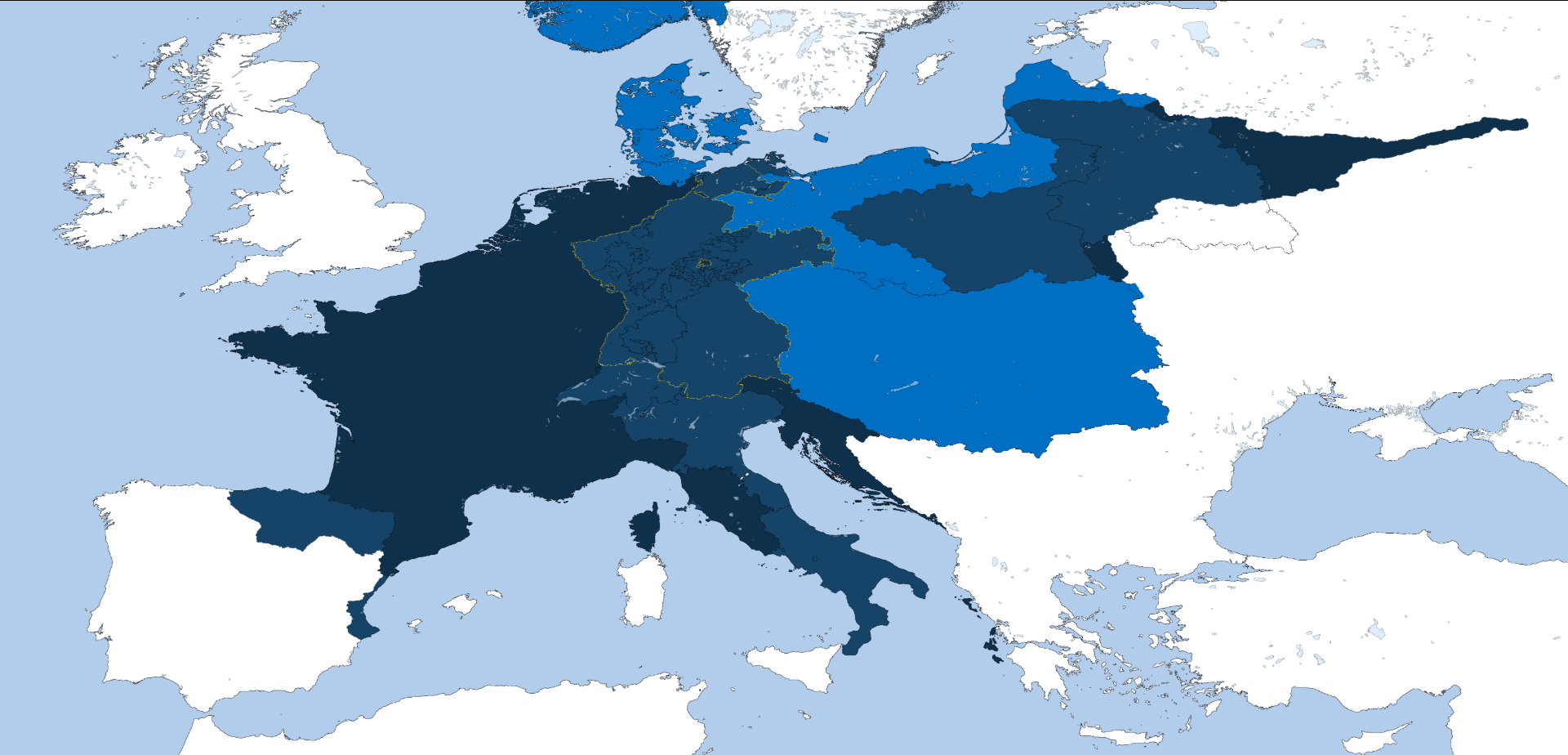
By 1812, the French Empire had reached its height. The army had grown to comprise 1,000,000 soldiers and their Emperor possessed a landmass spanning across the Continent. An impressive feat, but Napoleon would be defeated in 1814 just two years later, then more decisively in 1815. As was the case with Louis XIV four generations earlier, this could only be done in concert; it could only be done through a counterhegemonic balancing coalition of four great powers: Prussia, Austria, Russia, and most notably, the British Empire.10 In advance, the answer was "no," but as I shift to the more important section of this piece, Europe was asking the following question.
“Would Napoleon become the unifier of a continent divided since the fall of Rome?”11
I was recently reminded of a corroborative, but almost inversive framework to the "multi-Hitlered" schema that structured my previous article: Hitler I, Hitler II, and Hitler III. It was reflected by Henry Kissinger in his 2014 work entitled World Order. With a familiar, tripartite design, Kissinger positions his telling of European modern history around three points on the timeline — each followed a period of total war: the Peace of Westphalia (~1648), the Congress of Vienna (~1815), and the Post War European Order (~1945).
Each of these settlements correspond to the defeat of the three Continentalist bids for unification that I examine: the Holy Roman Empire, Napoleon’s Continental System, and the two German Reiche from 1871 to 1945 (Hitler I, II, & III respectively). And Kissinger’s three agreements instruct the behavior of Europe—a region which he calls, “the Pluralistic Order.”12
The pluralism ascribed to the European stage comes from Kissinger’s recognition that, historically, other settings have tended to have had only one great power that unifies a continental landmass through singular hegemony. He recognizes in contrast that “Europe has thrived on fragmentation and embraced its own divisions.”13
I’ll arrive at a critique of a notion embedded in his book, and it mostly pertains to the “balance of power” theory, which, in some cases, is not used as a descriptive term but comes with an air of prescriptive tonality. The theory can extend beyond theoretical value and be applied as an ideal, or as a policy—which Kissinger seems to herald. His model, however, mostly aligns with my own.
The main distinction worthy of note, for now, is that my 'Hitlers' are only used as a conceptual vehicle to help you “put your ecologist’s hat on,” i.e., to analyze state behavior in relation to their environment. The more specific aim is to invite my (probably attractive) reader to redraw the dividing line of interstate politics, and to analyze the world through the lens of Land and Sea.
The maritime vs continental dichotomy has amassed a vast body of literature with authors ranging from Thucydides to Carl Schmitt, and Foreign Affairs magazine even published an article on the matter as recent as 2025 (see S.C.M. Paine’s article here). In spite of this wide recognition, I still find the lens to be wildly underutilized.
To apply it, keep in mind that Europe stands out to Kissinger as being a case where no single dominant power has been strong enough to impose unity over a region. Instead of decisive hegemony, multiple great powers balanced against one another. Kissinger notes that the Roman Empire was the most recent unifying bid that had any staying power on the Continent. Only once since the fall of Rome has Europe achieved that level of universal rule that followed from the coronation of Charlemagne, but then only briefly as it was divided up after his succession.14 He continues by saying that, for “more than a thousand years, in the mainstream of modern European statecraft order has derived from equilibrium, and identity from resistance to universal rule.”15
Kissinger’s use of “equilibrium” in the quote above, is used in reference to the balance of power theory which he describes as Europe’s “intricate mechanism tending toward a balance that preserved each people’s interests, integrity, and autonomy.”16 If you look at the map of Europe and see *land* distributed across borders of the various nation states, you may agree with Kissinger here, and assume that each of the borders are autonomous, and that they balance against one another in lieu of a Leviathan. Balance of power theorists may disagree with my more Hobbesian notion, and instead believe that order can be maintained in absence of a regional hegemon.
“Despite their many disagreements, nearly all balance of power theorists would accept the following set of interrelated propositions: (1) the prevention of others from achieving a position of hegemony in the system is a primary security goal of states; (2) threats of hegemony generate great-power balancing coalitions; and (3) as a result, sustained hegemonies rarely if ever form in multistate systems.”17
There is great descriptive value to this theory. As I argue, however, it is flawed. Arguing against balance of power theorists who align themselves with the views mentioned above, my minimalist claim is that maritime powers are far less likely to develop counterbalancing coalitions regardless of their status on the dominance hierarchy. To extend the range of that argument, I posit that there is, and often has been a regional hegemon in Europe; continuing by suggesting that a balance of power system, even with the implied absence of a hegemon in the region doesn’t explain periods of peace, and in fact, only when external regional hegemony has been challenged has there been total war; and finally, war has occurred due to the balance of power—not in spite of it.
Since roughly Louis XIV, if not Charles V, the balance has been tilted in the favor of the maritime powers, who in fact, employ the term “balance of power” as a prescriptive tool to further secure their own hegemony. This is where the Continental/Maritime aspect is especially enlightening. It’s found missing in World Order but will be applied to the book’s content here.
Crucially, due to their environment and lack of an Oceanic moat, Continentalists value land, and recognize it as the source of their power. The “Hitlers” described in my series are powers in the early-modern to modern era that were driving toward European unification, and doing so through Continental means—i.e., through hard power, mostly presenting itself through the annexation of land. However, it’s important to recognize that maritime and continental states have different sources of power; continentalists value land whereas sea powers find their source in wealth.18 This is deeply related to persistent maritime trade practices, which they protect with strong navies in due course, and where finally they create financial institutions in relation to their trade regulating power. Each trait feeds back into the other; once established, they’re all jointly causal.
Indeed, after the Congress of Vienna in 1815, there was no hegemony to be found on the Continent itself, however, Europe still had a hegemon: the fiscal-naval state across the Channel. But that didn’t mean they “thrived on fragmentation” as Kissinger puts it—it only meant that they remained fragmented. The British Empire’s dominant role was taken up by their offspring following the Post War settlement, and then fully secured following the Cold War. However, Maritime empires like the U.S. and Great Britain, again, have a different source of power, and thus, its conquests do not resemble their Continental counterpart’s. The sea fairing states do not view power in terms of land—that is the realm of hard-power. Connoisseurs of soft-power that they are, they do not see power in those terms. Nevertheless, dominant influence persists and maritime powers have gone to great lengths to retain their hegemony.
The unification of Europe always posed the biggest threat to the British Empire, and the largest wars in their history have been fought to preclude Continental hegemony. In the Napoleonic context, this is because a united European continent would have in its possession more than enough resources for self sufficiency, which would (a) render the trade reliance Britain had developed obsolete; and along with that newly aggregated material, with extended open-water access, (b) the land dominance could be converted into naval supremacy—the central pillar that upheld Britain’s monopoly. A naval and/or trade rival had to be prevented because, as is the case for all maritime hegemons, the British were subject to the Competitive Exclusion Principle. Against the Hitlers, they obliged.
They mostly succeeded in maintaining Europe’s division, but they did lose another war across the Atlantic. It was fought against a rebellious, but ultimately infantile collection of colonies that mustn’t have appeared too threatening. However, within a century following their loss, Abraham Lincoln would fight hard to transform “these” United States into “the” United States. It is little surprise that the British supported the Southern Confederacy; as the U.S. has shown, an expansive, unified land-mass resembling the kind that Napoleon sought, would make it a small matter of time before the British were surpassed in the realm of maritime hegemony and territorial holdings alike. So why didn’t Europe unify? —a relevant question. It was the balance of power, that, on the one hand was descriptively applied by many, and on the other, prescriptively weaponized against the Continent to keep it “balanced” against one another, i.e., fractured.
Having brought up the U.S. in the last paragraph; few would question that it plays a hegemonic role today. Clearly then, hegemons can arise within their system—i.e., in their region, if not across the globe. But an “iron law” that balance of power theorists abide by suggests that “near hegemonic concentrations of power in the system nearly always trigger a counterbalancing coalition”19 . . . So, where is the United States' balancing coalition? We’ll keep waiting. But don’t get your hopes up, because a research paper published by International Security asked that very question, and found an answer in line with my own:
“Although great-power balancing coalitions often form against states amassing high concentrations of military power in autonomous continental systems, particularly in Europe, they generally do not form against states amassing high concentrations of naval power and wealth in the global maritime system. Predominant sea powers differ from dominant continental powers in their goals, strategies, and behavior, as well as in the responses they elicit from other leading states. Consequently the patterns of strategic interaction are fundamentally different in the two types of systems.”20
Like the ones before and after him, Hitler II was defeated by a balancing coalition. This time in the form of Austria, Russia, Prussia, and the British Empire—the latter would lead these efforts. Balancing coalitions are defined as a formal military alliance against a target state, and they would be employed when any state on the Continent gained a disproportionate level of power. This was often France due to its large population and its intermediate environment which can afford economic advantage from being a hybrid state that finds itself situated in the agriculturally prosperous South of Europe and the other half in the industrious North. The British viewed France accordingly as the French had always been the Continental power of chief concern in regard to European unification, and it faced the brunt of balancing coalitions subsidized by British finance, which then fueled petty national interests united against French rule. This was the case until the unification of Germany in 1871. The dynamic changed, and this was the real underpinning of the First World War that bled into a Second.
Insofar as ideological or (God-forbid) moral differences played a causal role in relation to the Napoleonic Wars or the World Wars, it was a secondary role—and as I would extend—a role that can be better understood with the Social Intuitionist’s approach; “moral reasoning is usually a post hoc construction, generated after a judgement has been reached.”21 <—The emphasis was my own. The judgement had been reached well before Hitler III, and yes, even before Hitler II. Stay tuned…
John J. Mearsheimer, The Tragedy of Great Power Politics, updated ed. (New York: W. W. Norton & Company, 2014), 282.
Britannica Editors. “levée en masse.” Encyclopedia Britannica, June 15, 2020. https://www.britannica.com/topic/levee-en-masse.
John J. Mearsheimer, The Tragedy of Great Power Politics, updated ed. (New York: W. W. Norton & Company, 2014), 282-285.
John J. Mearsheimer, The Tragedy of Great Power Politics, updated ed. (New York: W. W. Norton & Company, 2014), 274.
Britannica Editors. “War of the Grand Alliance.” Encyclopedia Britannica, March 5, 2025. https://www.britannica.com/event/War-of-the-Grand-Alliance.
Rahman, S. Ahmed Explorations in Economic History Fighting the Forces of Gravity - Seapower and maritime trade between the 18th and 20th centuries, 34.
https://www.britannica.com/event/Battle-of-Trafalgar-European-history
Alexander Grab, Napoleon and the Transformation of Europe, European History in Perspective (Houndmills, Basingstoke, Hampshire: Palgrave Macmillan, 2003), 12.
Alexander Grab, Napoleon and the Transformation of Europe, European History in Perspective (Houndmills, Basingstoke, Hampshire: Palgrave Macmillan, 2003), 12.
Alexander Grab, Napoleon and the Transformation of Europe (New York: Palgrave Macmillan, 2003), 29.
Henry Kissinger, World Order (New York: Penguin Press, 2014), 45.
Henry Kissinger, World Order (New York: Penguin Press, 2014), 11–48.
Henry Kissinger, World Order (New York: Penguin Press, 2014), 12.
Jack S. Levy, William R. Thompson; Balancing on Land and at Sea: Do States Ally against the Leading Global Power?. International Security 2010; 35 (1): 7–43. doi: https://doi.org/10.1162/ISEC_a_00001
Henry Kissinger, World Order (New York: Penguin Press, 2014), 12.
Henry Kissinger, World Order (New York: Penguin Press, 2014), 12.
Jack S. Levy and William R. Thompson, “Balancing on Land and at Sea: Do States Ally against the Leading Global Power?” International Security 35, no. 1 (Summer 2010): 12.
S. C. M. Paine, “By Land or by Sea.” Foreign Affairs, August 19, 2025. https://www.foreignaffairs.com/united-states/land-or-sea-paine.
Jack S. Levy, William R. Thompson; Balancing on Land and at Sea: Do States Ally against the Leading Global Power?. International Security 2010; 35 (1): 7–43. doi: https://doi.org/10.1162/ISEC_a_00001
Jack S. Levy and William R. Thompson, “Balancing on Land and at Sea: Do States Ally against the Leading Global Power?” International Security 35, no. 1 (Summer 2010): 8.
Jonathan Haidt, “The Emotional Dog and Its Rational Tail: A Social Intuitionist Approach to Moral Judgment,” Psychological Review 108, no. 4 (2001): 814.