

The English have played a particularly crucial role in this series. We opened with an examination of English colonies in the New World, and the following posts have focused on them in the Old. This was not done without intent, as I see the British in the 17th to 19th centuries as the vehicle to modernization; and it is there that we find the point of convergence between the prime subjects.
More specifically, the convergence-point between the Reformation and modernity was the continental vs maritime showdown between France and Great Britain from 1793-1815.
Most specifically, it was 1815. As was described in the the last post, the British defeat of Napoleon yielded uncontested naval, trade, and financial dominance across the world. It would produce the first global empire, and with it came global influence, such that the Anglos were able to define “modernization” itself. They got to decide what the word meant, and then use it as a metric to scale how similar other societies were to themselves—true power.
“The masters’ right of giving names goes so far that it is permissible to look upon language itself as the expression of the power of the masters: they say “this is that, and that,” they seal finally every object and every event with a sound, and thereby at the same time take possession of it.”1
Genealogy of Morals, First Essay §2.
To a notable nineteenth century German, the English were a loathsome race. Not because they lacked a “will to power” (which they so clearly had) but due to them not wanting to have it. To Friedrich Nietzsche, an artist, they were too utilitarian, too universalistic, too scientific, too Christian, and too moral. And to a self-proclaimed Dionysian like Nietzsche, and one who was skeptical of morality itself, British global hegemony was seen as carrying great risk. He understood that the expansionistic conversion project that so defines the spread of Christianity, was now driving a distinctly British vehicle.2
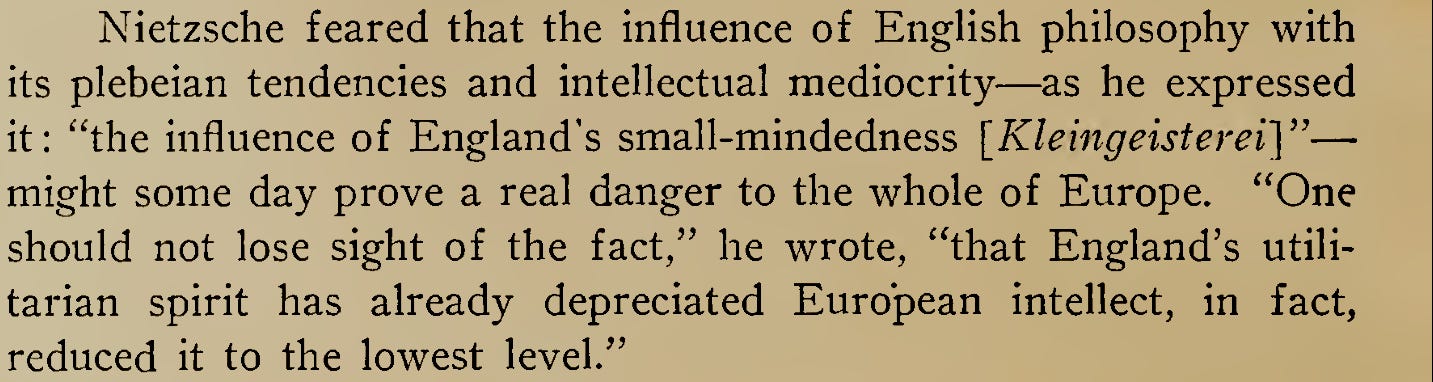
Regarding the BQ (the British question) Nietzsche was primarily concerned with philosophy becoming nothing deeper than a science of morality.3 Rejecting the idea of Plato’s absolute Good, he didn’t believe the British knew what was “right” or “wrong” for society, and doubted the extent to which those concepts existed at all. If they did, was universalizing “the good” even an admirable goal? That too was dubious.4
What he could observe however, was the universalistic, flattening, and morality-imposing attributes embedded in all of his critiques aimed at the project of Christianity, and the Colonial British empire alike.5 As I see it, these characteristics are indeed causative in the Empire’s ultimate collapse.
But in contradiction, the very same traits that Nietzsche was so presciently averse to, were also the source of British power at an earlier stage of their history. Through the excuse of “Christianizing” the world, then “civilizing” the world, and finally “modernizing” the world, the Brits had enabled themselves to conquer with moral justification6. Their morality became the world’s morality, enforced first through tangible means, and then backed by moral codes (e.g., contrived fantasy such as “international law”)7. More crucial than the colonial “hard power” is what remained; a particularly moralistic strain of soft power.
“There are systems of morals which are meant to justify their author in the eyes of other people; other systems of morals are meant to tranquilize him[.]”8
F.N., Beyond Good and Evil §187.
Regarding the quote above, and reflecting on the eventual collapse of the Empire, the English seem to have done both; first justifying great and terrible successes, then tranquilizing themselves into abject submission on the world stage. First in the long 19th century, then in the long 20th—first in power, then in self-induced defeat—first as tragedy, then as farce, and so on...
Anyway, we will move on from this discussion of the English character (for now), but I wanted to prefigure some things to come: Firstly, I want this dialectical behavior of “modernity” kept in mind; there is an inversive pattern here that can be recognized when the principles that make a historical movement successful, become the very same that lead to its demise. An example of that pattern can be observed in my addendum to Part I here. That concept will reemerge (most significantly in the concluding piece of this limited series). And the final thing to keep in mind is this:
To discuss the British is to discuss modernization. It then feels necessary to define what is meant by modernization, as it means something rather specific. I will provide this according to a founder of modernization theory, Talcott Parsons. Parsons defines it according to six characteristics: A society is modernized if it has recognizable preferences for (1) individualism over collectivism, (2) secular science over religion and mythology, (3) having specialized divisions of labor, (4) not having dominance hierarchies rooted in heredity, (5) having industrial economies more prominent than agricultural ones, (6) and being universalistic, more so than particularistic.9
And here’s a simpler definition from the Encyclopedia Britannica, which emphasizes the industrialization aspect by restating one idea in like seven different ways repeatedly:
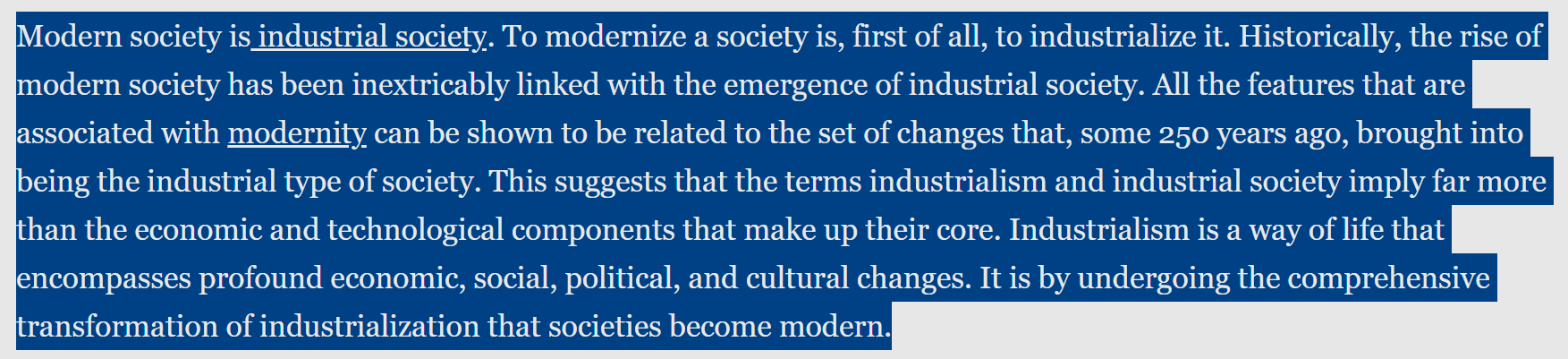
Which is funny—but it’s not wrong. So let’s keep that in mind for the next post; Industrial Society = Modern Society.10 Again, almost every systemic innovation that could be most proximately associated with “the modern world” finds provenance in the English, including the industrial revolution. Note that the first industrial revolution was British and is considered to have occurred from the years 1760-1840.
As established in Part III, 1815 is the center of our historical narrative—but we can then “zoom out” a bit and find a broader range of centrality. What do I mean by that? I mean to say that 1815 is the most central of centers, but it remains embedded in layers. Waterloo (1815) marks the end of the French Revolutionary and Napoleonic Wars (1793-1815), but that war itself was contained within the industrial revolution (1760-1840), and both of which are subsumed in the financial revolution (1688-). The significance of each layer cannot be understated, all are a cascade of dependent phenomena, all are British phenomena, all of it builds into modernization, and all of it will be among the topics considered in my forthcoming post.
While 1815 marks the beginning of the British empire, 1688 marks the beginning of Britain as a state—a quintessentially modern state, and a state that was made by money, enabling it to finance military campaigns designed to preclude the emergence of a continental hegemon11. France in this case. Germany in another…
Friedrich Nietzsche, The Genealogy of Morals: A Polemic, trans. Horace B. Samuel (Project Gutenberg, eBook no. 52319, last updated October 23, 2024), First Essay, §2, accessed December 17, 2025, https://www.gutenberg.org/files/52319/52319-h/52319-h.htm.
(2a) Friedrich Nietzsche, On the Genealogy of Morals, trans. Walter Kaufmann and R. J. Hollingdale (New York: Vintage Books, 1989), preface; First Essay, aphs. 4–8.
(2b) Friedrich Nietzsche, Beyond Good and Evil, trans. Walter Kaufmann (New York: Vintage Books, 1989), aphs. 186–203.
(2c) Nietzsche critiques the English overtly and often. His opinions on the matter are scattered throughout his work and I have provided only two sections to refer to (see footnote 2a and 2b above). Due to the critiques being so numerous, it is very difficult to cite in a uniform manner. Furthermore, his commentary is often deployed with artistic subtlety, rendering it difficult to point to an exact passage on the subject that could be understood without context. Roughly, I am aggregating his commentary on the English, his opinions on morality more broadly, pulling from several of his books that I have engaged with deeply, and then applying it in the context of this series by embedding it into a (hopefully) respectable historical narrative. I feel that most students of Nietzsche would accept this application as true to his line of thinking—but if you are skeptical of this reading of Nietzsche, I’d be happy to discuss it further with you. I understand that there is a broad variety of ways he can be interpreted.
See footnote 2.
(4a) Aaron Ridley, “Nietzsche’s Ethics,” Internet Encyclopedia of Philosophy, accessed December 14, 2025, https://iep.utm.edu/nietzsches-ethics/.
(4b) See footnote 2.
Friedrich Nietzsche, Beyond Good and Evil, trans. Walter Kaufmann (New York: Vintage Books, 1989), aphorism 187.
Jennifer Pitts, “Empire and Legal Universalisms in the Eighteenth Century,” American Historical Review 117, no. 1 (February 2012): 94.
Pitts, “Empire and Legal Universalisms in the Eighteenth Century,” 92–121.
Friedrich Nietzsche, Beyond Good and Evil, trans. Walter Kaufmann (New York: Vintage Books, 1989), aphorism 187.
Leonid L. Kyianytsia, “The Modernization Theory Paradigm and Its Discontents: Reviewing the Contribution and Fallings of the Modernization Theory to Social and Political Research,” Ukrainian Policymaker 8 (2021): 42, https://doi.org/10.29202/up/8/5. ResearchGate+1
Kumar, Krishan. “modernization”. Encyclopedia Britannica, 11 Apr. 2025, https://www.britannica.com/topic/modernization. Accessed 15 December 2025.
Alexander Murdoch, “The Idea of Britain and the Creation of the First British Empire,” in British History, 1660–1832: National Identity and Local Culture, chap. 5 (London: Palgrave Macmillan, 1998), 64.